Lead Qualification: Frameworks, Questions, and How to Qualify Leads Before the Call (2026)
Lead qualification is deciding which leads are worth a salesperson's time. The main frameworks compared, the questions to ask, a six-step process, and how to qualify paid social leads inside the funnel instead of on the phone.
 Faheem MushtaqCo-Founder & CTO
Summarize this article with
 ChatGPT
 Claude
 Perplexity
 Grok
Lead qualification is the process of deciding whether a lead is a good enough fit, and ready enough to buy, to deserve a salesperson's time. A qualified lead matches the customer you can serve, has a real need, and has shown some sign that they intend to act. Everyone else gets nurtured, redirected or let go.
Most guides treat qualification as something a sales rep does on a discovery call. For teams buying leads with Instagram, TikTok or Facebook ads, that is the expensive place to do it. This guide covers the frameworks and the process, then shows how to move most of the qualifying into the funnel itself, so the calls on the calendar come from people who already fit.
Key takeaways
- Lead qualification answers two questions: fit and intent. Fit is whether the lead matches who you sell to. Intent is whether they are likely to act soon.
- Lead qualification and lead scoring are not the same thing. Qualification is the decision; scoring is one way of making it repeatable.
- BANT, CHAMP and MEDDIC are the frameworks most teams start from. BANT is widely attributed to IBM's sales organisation, and MEDDIC is credited to Dick Dunkel and Jack Napoli at PTC in the 1990s.
- Sales time is scarce. Salesforce's State of Sales report, published 3 February 2026, found the average seller spends 40% of their time selling.
- Paid social leads need qualifying at the point of capture. A form that takes one tap to submit tells you almost nothing about fit or intent.
- Qualify with tap-to-answer questions that carry points, then route by the total. High scores go to a calendar, middle scores get a callback, low scores get a useful resource instead of a sales call.
What is lead qualification?
Lead qualification is the step between capturing a lead and spending sales effort on it. It sorts leads into the ones a salesperson should contact now, the ones marketing should keep nurturing, and the ones that will never buy.
Most qualification criteria fall into two groups:
A lead with strong fit and weak intent is a nurture lead. A lead with strong intent and weak fit is the most dangerous kind, because they are eager to talk and will never buy. Good qualification catches both.
MQL vs. SQL
Two labels describe where a lead sits in the process. A marketing-qualified lead (MQL) has met marketing's criteria — usually fit plus some engagement — and is ready to be handed to sales. A sales-qualified lead (SQL) has been checked by sales and confirmed as worth pursuing as an opportunity. The handoff between the two is where most qualification arguments between marketing and sales happen, so write the criteria for each down and agree on them.
Lead qualification vs. lead scoring
Lead qualification is the decision about whether a lead is worth pursuing. Lead scoring is a method of making that decision consistently, by giving points to attributes and actions and setting a threshold.
A small team can qualify leads without a score: a rep reads the answers and decides. Scoring becomes necessary when volume rises, when several people make the call, or when the decision needs to happen automatically — for example, deciding in real time whether to show a booking calendar. The quiz funnel guide covers how answer scoring works step by step.
Lead qualification frameworks compared
A lead qualification framework is a checklist of what a lead must have before sales invests in them. The five most used are below.
BANT is the oldest and the simplest, and it is widely attributed to IBM. Its weakness is that budget comes first, and many buyers have not set a budget until they understand the problem. CHAMP fixes that by asking about challenges first. MEDDIC and MEDDPICC are built for long enterprise sales cycles and are overkill for a home services company or a coach booking strategy calls.
For businesses running paid social traffic, the practical framework is usually a stripped-down BANT: need, timeline, budget range and fit (location, size or eligibility). Authority matters less when the person tapping the ad is also the person paying.
The lead qualification process, step by step
The lead qualification process turns a pile of contacts into a ranked list a sales team can work from. Six steps cover it.
1. Define your ideal customer. Write down the attributes of customers who bought, paid on time and stayed. That list becomes your fit criteria.
2. Pick the few questions that predict a sale. Look at won and lost deals and find the answers that separated them. Usually it is three to five things: budget range, timeline, location or service area, and the specific problem.
3. Ask those questions before the lead reaches sales. Ask them in the funnel, the form or the ad's instant form — not on the first call.
4. Score and set thresholds. Give points to answers that predict a sale and zero to the rest. Decide which total means "book a call", which means "call back", and which means "nurture".
5. Route each lead by its result. Qualified leads go to the calendar or straight to a rep. Middle leads get a follow-up sequence. Unqualified leads get something useful and leave the sales queue.
6. Close the loop. Every month, compare the scores with what actually happened. If high-score leads are not closing, change the points.
Response time sits alongside this process, not inside it. The speed to lead statistics page traces the research on how quickly the odds of reaching a lead fall after they submit.
Lead qualification questions to ask
The best lead qualification questions can be answered in a few seconds and separate buyers from browsers. For leads arriving on a phone, every question should be answerable with a tap.
Ask budget as a range, never as an open text box. Ranges are faster to answer on a phone, easier to score and less confrontational than "What is your budget?" Always include an honest "Not sure" option, so people who would otherwise abandon can keep going.
Recruitment funnels qualify candidates the same way; the candidate screening questions guide lists the role-specific version.
Why paid social leads need qualifying at the point of capture
Paid social leads are cheap to submit, which is exactly why they need qualifying. A person scrolling Instagram can send their details in seconds, often with fields already filled in for them, and that leaves a sales team calling people who barely remember the ad.
Meta's instant forms prefill the person's name, email and phone number from their account, as the Instagram lead ads guide covers in detail. That makes submitting easy and makes the contact details almost useless as a qualification signal. The problem is sharper in regulated categories: Meta won't let mortgage lead generation campaigns target by age, ZIP code or lookalike audience, so the questions after the click are the only filter left.
There are three places to qualify a paid social lead:
The economics point toward qualifying as early as possible. Salesforce's State of Sales report, published 3 February 2026 and based on a survey of 4,050 sales professionals, found that the average seller spends 40% of their time selling, and that 48% say they lack the bandwidth for adequate cold outreach. Every unqualified call comes out of that 40%.
A multi-step form is the usual format for this: one question per screen, contact details last, and the qualifying questions doing the work in between.
A worked example: qualifying a renovation lead from an Instagram ad
Here is how a kitchen renovation company could qualify leads from an Instagram ad inside a funnel. The scoring below is illustrative, not a benchmark — build yours from your own won and lost deals.
The ad sends the tap to a funnel with four questions, one per screen, before the contact details.
The maximum score is 10. The routing after the contact step has three branches:
- Score 8–10: show the booking calendar straight away, so the lead books a design consultation while their intent is highest.
- Score 4–7: confirm that someone will call within a business day, and send the lead to the sales team's CRM pipeline with the answers attached.
- Score 0–3: show a cost guide or an ideas gallery instead of a sales call, and add the lead to a nurture list.
Two rules make this work. First, a "No" to the service-area question should override the score entirely and route to a polite "we don't cover your area yet" ending, because no amount of budget fixes a lead you can't serve. Second, the rep should see every answer, not just the total, so the first call starts from what the person already said.
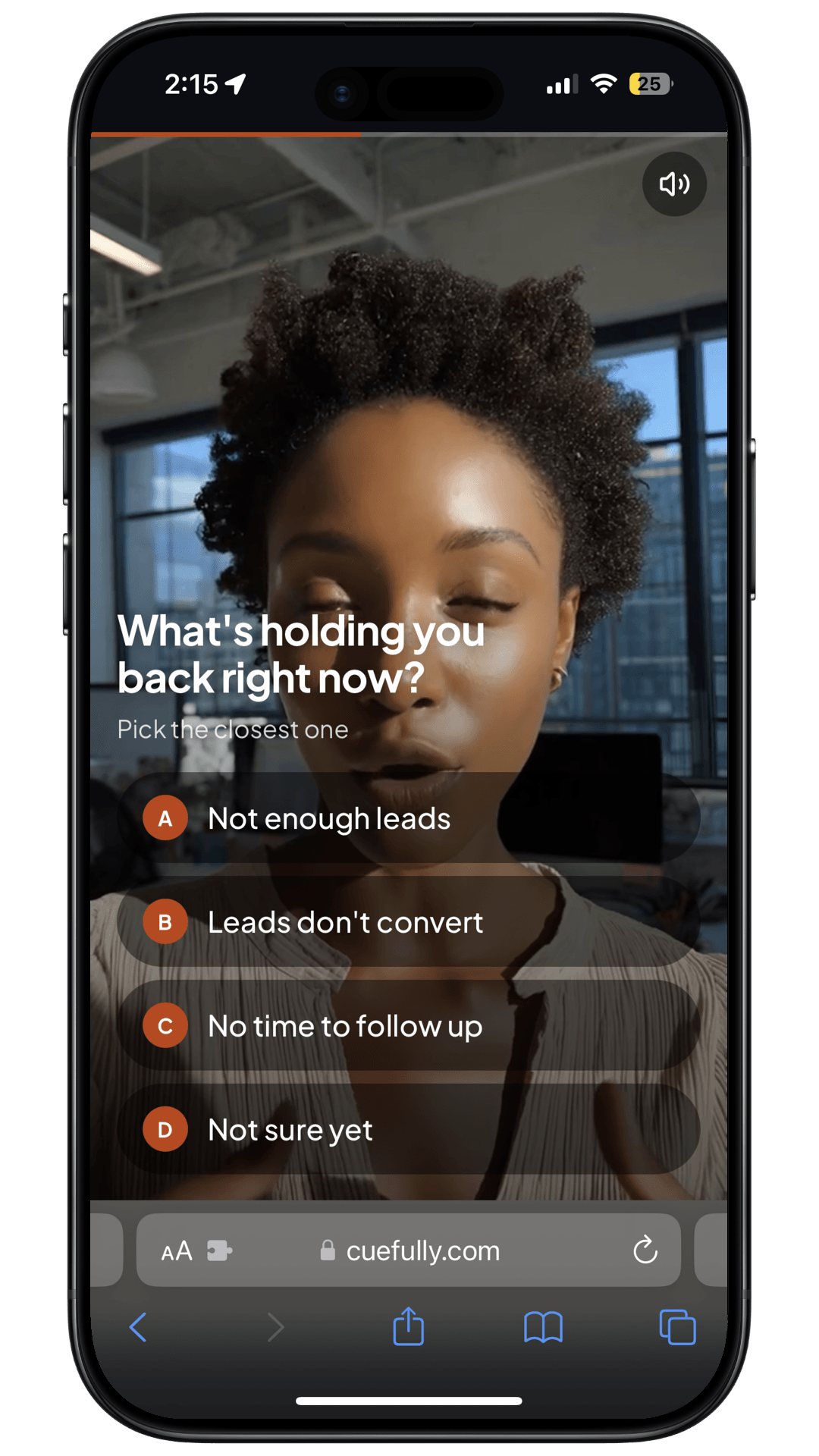
In CueFully, each answer option can carry points, the total is published as Lead score, and any later step can branch on whether the score is above, below or equal to a threshold. The metabolism quiz template shows score-based routing out of the box: every answer carries points, and the total picks one of three result pages. The appointment booking template and the coaching application funnel template end in a calendar; add points to their qualifying questions to route by score. If you'd rather put a face on the questions, the video lead qualification funnel has a host ask about the challenge, timeline and budget on video, and sends budgets under $500 to a free guide instead of the calendar. The booking funnel guide covers the calendar half of the flow.
What to do with leads that don't qualify
An unqualified lead is not a wasted lead; it is a lead with the wrong timing or the wrong offer. Routing them well protects the sales team and keeps the door open.
- Wrong timing: send a nurture sequence and ask the timeline question again later.
- Wrong budget: offer a smaller product, a guide or a do-it-yourself option.
- Wrong fit: say so clearly, and point them somewhere useful if you can.
- Just researching: give them the resource they came for, such as a guide, a calculator or a price list.
Never hide the fact that someone didn't qualify behind a fake "we'll be in touch". If no one will call, the ending should say what happens next.
Feed qualification back into your ad account
Qualification data is also the best signal you can give an ad platform. If Meta only knows that someone submitted a form, it will find more people who submit forms. If it knows which leads qualified, it can look for more of those.
Meta's conversion leads performance goal does this for instant form campaigns. Meta's developer documentation for the Conversions API CRM integration says the goal is only compatible with Facebook and Instagram lead ads using instant forms. It recommends at least 200 leads per month, a target funnel stage that happens within 28 days of the lead, and a conversion rate for that stage between 1% and 40%. Leads from website funnels are optimised with Meta Pixel and Conversions API events instead, so send a distinct event when a lead qualifies, not only when they submit. The Conversions API setup guide for lead funnels shows an event map for exactly this.
Common lead qualification mistakes
- Asking too much, too early. Put the easiest question first and contact details last.
- Scoring every answer. If most options earn points, the total stops meaning anything. Most options should score zero.
- Open text for budget and timeline. Free text can't be scored and slows people down on a phone.
- No "Not sure" option. People who can't answer honestly either abandon or lie.
- Never revisiting the scores. Thresholds set on day one drift out of date as offers and audiences change.
- Qualifying on the call only. It is the slowest and most expensive place to find out a lead was never a fit.
Frequently asked questions
What does lead qualification mean? Lead qualification means deciding whether a lead is worth a salesperson's time. It checks fit — whether the lead matches the customer you serve — and intent — whether they are likely to act soon.
What is the best lead qualification framework? BANT is the best starting point for simple, short sales, and MEDDIC or MEDDPICC suits complex enterprise deals. For businesses running paid social ads, a short version of BANT built around need, timeline, budget range and fit usually works best.
How do you qualify leads from Facebook and Instagram ads? Ask three to five tap-to-answer questions before contact details, score the answers that predict a sale, and route each lead by its score. Qualified leads go to a calendar or a rep, and the rest get a nurture sequence or a useful resource.
What questions should I ask to qualify a lead? Ask what they need, when they want to start, what budget range they are working with, and whether they fit your service area or customer profile. Offer each as multiple-choice options with a "Not sure" answer.
What is the difference between lead qualification and lead scoring? Lead qualification is the decision about whether to pursue a lead. Lead scoring gives points to answers and behaviours so that decision can be made consistently, and automatically when volume is high.
What is the difference between an MQL and an SQL? A marketing-qualified lead has met marketing's criteria and is ready for sales. A sales-qualified lead has been checked by sales and confirmed as worth pursuing as an opportunity.
Sources and method
Sources were checked on 4 November 2026. The worked example is illustrative and its point values are not a benchmark.
- Salesforce — "State of Sales" report announcement, 3 February 2026 — average seller spends 40% of their time selling; 48% lack bandwidth for adequate cold outreach; survey of 4,050 sales professionals, August–September 2025.
- Meta for Developers — "Conversions API for CRM integration" — conversion leads compatibility with instant forms only; 200 leads per month, 28-day window and 1–40% stage conversion rate recommendations.
- *[Andy Whyte, MEDDICC (foreword by Dick Dunkel)](https://www.perlego.com/book/3013688/meddicc-the-ultimate-guide-to-staying-one-step-ahead-in-the-complex-sale-pdf)* — MEDDIC's origin at PTC in the mid-1990s.
- BANT — widely attributed to IBM's sales organisation; we found no primary IBM document, so no date is given.
- CueFully lead score — answer points, the Lead score total and threshold branching, as documented in the product.
Paying for leads your sales team then has to sort by hand? See a qualifying funnel on your phone — then start free with CueFully.
Build from the guide
Start with the Video Lead Qualification Funnel template
Start from a complete mobile-first flow, customize it for your client, and publish a funnel that captures qualified leads without adding developer work.