Roofing Lead Generation: The Channels That Work, and How to Turn Facebook Ads Into Booked Inspections (2026)
Roofing lead generation is how a roofing company gets homeowners who need a repair, replacement or inspection to contact it. The main channels compared, what Meta leads cost in home improvement, and a step-by-step mobile funnel for roofing ads.
 Faheem MushtaqCo-Founder & CTO
Summarize this article with
 ChatGPT
 Claude
 Perplexity
 Grok
Roofing lead generation is the work of getting homeowners and property managers who need a roof repair, replacement or inspection to contact your roofing company. The main channels are referrals, Google search (local SEO, Google Ads and Local Services Ads), Facebook and Instagram ads, bought leads, door knocking and repeat customers. Referrals still bring in the most work, but they can't be turned up on demand. Paid social can be, and it is the channel where the page a homeowner lands on decides whether you get a booked inspection or a wasted click.
This guide compares the roofing lead channels, shows what home improvement leads cost on Meta, and walks through a mobile funnel for roofing ads, screen by screen. It is written for roofing companies running their own ads and for agencies running ads for roofers.
Key takeaways
- Referrals are the biggest source, search is second. In Roofing Contractor's 2025 homeowner survey, 79% of homeowners said they find roofers by word of mouth and 62% through online search engines.
- Getting new leads is the main growth problem. Roofr's Roofing by the Numbers 2025 report found 63% of roofing business owners name generating new leads as their number one growth challenge.
- Social media is widely used and rarely the best channel. The same Roofr report found 53% of roofers use social media to attract customers, but only 15% call it their most effective channel.
- Meta leads cost more in home improvement than average. LocaliQ and WordStream's Facebook ads benchmarks (updated 23 September 2026) put the Home & Home Improvement cost per lead at $42.95, against $27.39 across all industries.
- Facebook and Instagram traffic is low-intent and arrives on phones. The homeowner wasn't searching for a roofer, so the funnel has to qualify them, not just collect a phone number.
- Speed decides who wins the job. Roofr reports that over 40% of roofing leads go to the first contractor to respond.
What is roofing lead generation?
A roofing lead is a person who has asked a roofing company to contact them about a specific job. That includes a quote request, a call, a booked inspection, or a form submitted from an ad.
Roofing lead generation covers two different approaches:
An exclusive lead is sold to one contractor only. A shared lead is sold to several, which turns every enquiry into a race and a price comparison. Generating your own leads is the only way to be sure every lead is exclusive.
Where do homeowners find roofing contractors?
Most homeowners find a roofer through people they know, then check them online. Roofing Contractor's 2025 homeowner survey, published on 13 February 2025, found:
The same survey found 67% of homeowners rate online reviews as extremely or very important. It also found 78% are more likely to call a contractor that makes its pricing transparent on its website.
The contractor side agrees. Roofr's Roofing by the Numbers 2025 report found 71% of roofers rely on word-of-mouth referrals from past customers. It also found 63% of roofing business owners name new leads as their biggest growth challenge.
Those two numbers explain why roofers turn to paid channels. Referrals produce the best leads, but a roofing company can't order more of them when the crew calendar has gaps.
Roofing lead generation channels compared
Every channel sits somewhere between high intent and high control. A homeowner searching "roof leak repair near me" wants a roofer today. A homeowner scrolling Instagram doesn't, until your ad reminds them their roof is twenty years old.
Search channels capture demand that already exists. Paid social creates demand from homeowners who weren't looking yet. That is why Facebook and Instagram are the channels most roofing companies and their agencies use when they need more leads next month, and also why those leads disappoint when the funnel behind the ad is weak.
What do roofing leads cost on Facebook and Instagram?
Home improvement leads cost more on Meta than the cross-industry average. LocaliQ and WordStream's Facebook ads benchmarks, last updated on 23 September 2026, report these figures for lead campaigns:
The benchmark covers the whole Home & Home Improvement category, not roofing alone. A roof replacement is a larger, rarer purchase than most home improvement jobs, so treat these as a floor for expectations, not a target.
The more useful number is the cost per booked inspection, because a cheap lead that never answers the phone costs more than an expensive one that books. For cost per lead across channels and industries, see our average cost per lead by industry roundup.
Why roofing Facebook ads produce bad leads
Roofing Facebook ads don't fail because Facebook doesn't work for roofers. They fail because the funnel behind the ad is built for a homeowner who searched, not one who scrolled.
The homeowner wasn't looking for a roofer. Someone who taps an ad between stories is curious, not committed. A form that asks only for name and phone collects curiosity, and the sales team spends its day calling people who don't remember submitting.
Instant forms make submitting too easy. Meta's instant forms can prefill name, email and phone from the person's account, so one tap can send a lead. That raises volume and lowers intent. Our guide to Instagram lead ads covers when an instant form is the right call and when a website funnel gets better leads.
The landing page was built for desktop. Most roofing websites send ad clicks to a contact page with a long form under a hero image. Zuko's 2025 industry benchmarking puts form view-to-completion at 31.3% on mobile against 37.2% on desktop. A click from the Facebook or Instagram app opens on the phone it was tapped on, so the mobile number is the one that applies. Our lead form guide covers which fields cost the most completions.
Targeting may be restricted. Jon Loomer's guide to Meta's special ad categories, last updated on 1 March 2025, lists "housing repairs" among the ads covered by the Housing category. Housing ads must target all ages from 18 to 65+, all genders, at least a 15-mile radius, and no ZIP codes, and they can't use lookalike audiences. Check Meta's own Housing category page before launch, because Meta decides whether your ad must be declared. When targeting is broad, the funnel has to do the filtering.
Nobody calls back fast enough. A lead that waits until the next morning has often already booked someone else.
How to build a roofing lead funnel for Facebook and Instagram ads
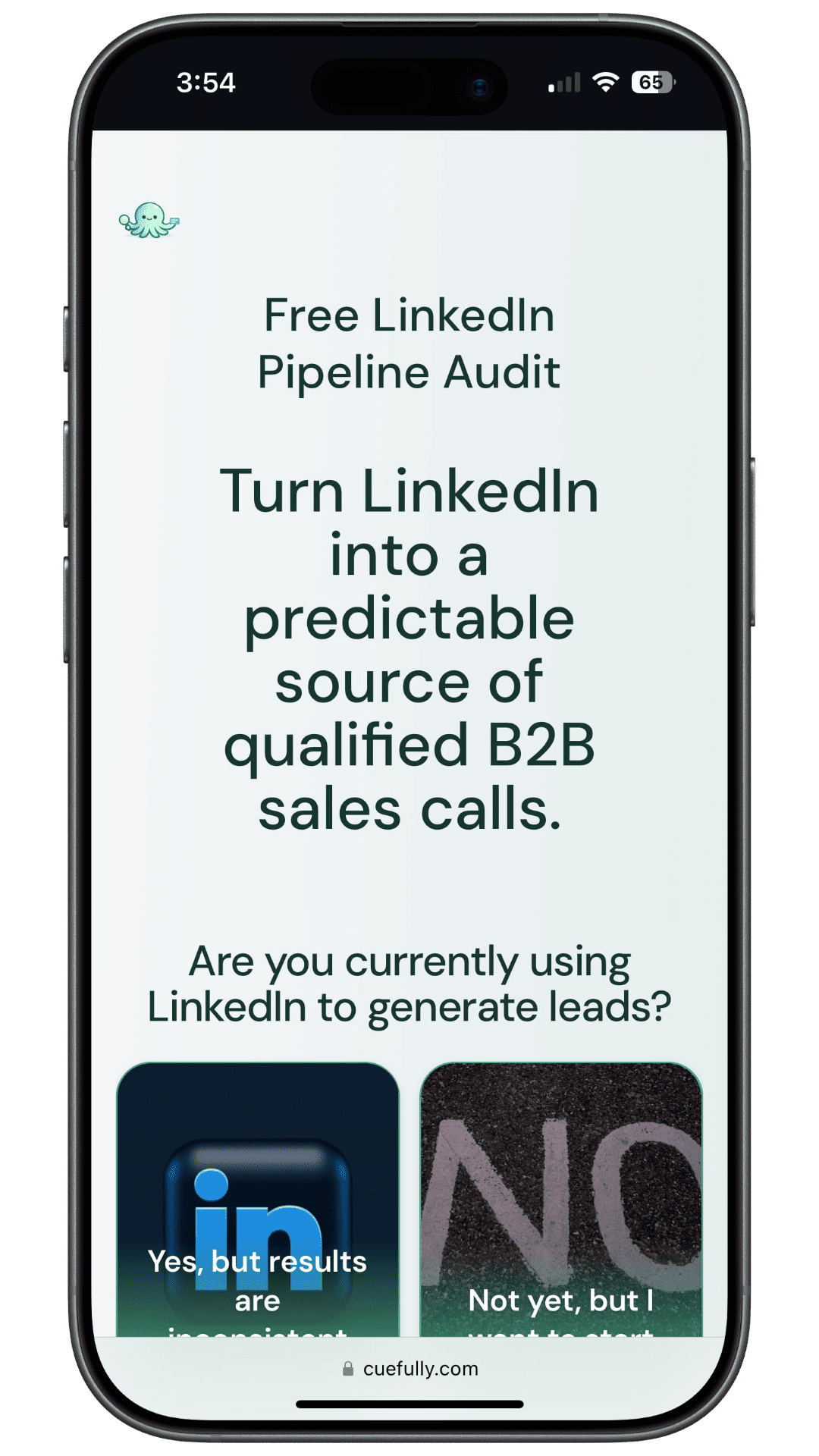
A roofing lead funnel is a short sequence of phone-sized screens that qualifies a homeowner before asking for their contact details. One question per screen, answered by tapping, with the phone number near the end.
1. Pick one offer per campaign
The offer is what the homeowner gets for tapping. Match it to what the ad promised, and run one offer per campaign:
Roofing Contractor's survey found 78% of homeowners are more likely to call a contractor that is open about pricing. A typical price range on the offer screen, or an estimated range at the end of the funnel, gives the homeowner a reason to finish.
2. Ask the questions that decide the visit
Every question should change who calls, what they say, or whether you go out at all. Useful roofing questions:
- Do you own the home? (Homeowner, Renting, Buying)
- What's going on with your roof? (Leak, Storm damage, Old roof, Planning a replacement)
- What type of property is it? (Single-family, Townhouse, Multi-family, Commercial)
- Roughly how old is the roof? (Under 10 years, 10–20, Over 20, Not sure)
- Are you planning an insurance claim? (Yes, No, Not sure)
- When do you want the work done? (As soon as possible, Within 3 months, Just researching)
- What's the property's ZIP code? (to confirm the service area)
Each of those is a tap, except the ZIP code. Tap-to-answer questions keep a phone visitor moving, and each answer is captured as they go, so you learn why people drop off. Our guide to multi-step forms covers why this order beats a single long form.
3. Branch and disqualify early
A renter can't approve a roof replacement, and an address outside your service area is a lead you'll never visit. Send those visitors to a polite exit screen instead of the calendar. Send storm-damage visitors to an insurance-claim question that general inspection visitors never see.
That routing is the difference between a funnel and a form. Our lead qualification guide covers how to score answers so the hottest leads get called first.
4. Ask for contact details last, then book the visit
By the time a homeowner has answered six questions about their roof, asking for a name and phone number feels like the obvious next step. Ask for them on one screen, say exactly why ("so we can confirm your inspection time"), and offer a calendar slot on the next screen. A homeowner who picks a time has committed more than one who typed a number. A booking funnel that qualifies before it shows the calendar is this exact shape.
5. Send the lead to the people who call it, immediately
Roofr reports that over 40% of roofing leads go to the first contractor to respond. Route every submission to wherever the sales team already works: a Slack channel, a shared Google Sheet, or the roofing CRM through a webhook. Our speed-to-lead statistics cover what the research does and doesn't prove about response time.
6. Tell Meta which leads were good
Install the Meta Pixel and the Conversions API so Meta sees submissions that ad blockers and browser privacy settings would otherwise hide. Then fire the conversion on qualified leads, not on every submit. If Meta learns that "lead" means "homeowner, inside the service area, roof over 15 years old", it looks for more people like that.
Worked example: a storm damage inspection funnel
Here is a funnel for a roofing company running a storm campaign after a hailstorm. It is illustrative and reports no results.
The home valuation funnel uses the same pattern for a different trade: questions about the house first, then a site visit booked while the homeowner is still on the page. A roofing company can copy its structure and swap the questions.
For an agency running several roofing clients, each client's funnels, leads and brand kit should live in its own workspace, so one roofer's leads never appear in another's dashboard. Our guide to choosing a funnel builder as an agency covers what to check.
How to measure roofing lead generation
Cost per lead is the number everyone reports and the one that misleads most. Track the whole chain:
Then look at drop-off per funnel step. If 40% of visitors leave on the roof age question, the question is the problem, not the ad. Per-step analytics show which screen costs you the lead.
Common roofing lead generation mistakes
- Sending ad clicks to the homepage. The homepage serves every visitor; a funnel serves the one who tapped this ad.
- Asking for the phone number first. Phone is one of the most abandoned form fields, and asking for it first gives the homeowner no reason to stay.
- Optimising Meta for lead count. Meta will find the people most likely to submit, not the people most likely to buy a roof.
- One funnel for every offer. A storm check and a replacement estimate need different questions.
- Slow follow-up. A lead called tomorrow has often already let another roofer in.
- Judging the channel on cost per lead alone. Compare channels on cost per booked inspection and cost per signed job.
Frequently asked questions
What is the best way to get roofing leads? Referrals bring the highest-quality roofing leads, and 79% of homeowners in Roofing Contractor's 2025 survey said they find roofers by word of mouth. To grow beyond referrals, combine Google search channels for people searching now with Facebook and Instagram ads for homeowners who aren't looking yet, and send ad traffic to a qualifying funnel.
Do Facebook ads work for roofers? Yes, when the ad sends homeowners to a funnel that qualifies them and books an inspection. Facebook ads reach homeowners before they search, so the leads are lower-intent than search leads. The funnel's questions, routing and fast follow-up turn that traffic into appointments.
How much does a roofing lead cost? It depends on the channel and how you define a lead. LocaliQ and WordStream's Facebook ads benchmarks (updated 23 September 2026) put the average Meta cost per lead for Home & Home Improvement at $42.95. Roofing jobs are larger than most home improvement jobs, so measure cost per booked inspection rather than cost per lead.
Should I buy roofing leads or generate my own? Bought leads are fast to start but may be shared with other roofers. Generated leads take longer to set up but are exclusive to you. Most roofing companies use bought leads to fill gaps and invest in their own channels for the long term.
Should I use Meta instant forms or a landing page for roofing ads? Use instant forms when you want volume and your team will qualify every lead by phone. Use a mobile funnel when you need to filter out renters, out-of-area addresses and people just researching before anyone calls.
What questions should a roofing lead form ask? Ask whether they own the home, what the roof problem is, the property type, roof age, insurance claim plans, timing and ZIP code, then contact details. Each question should change who calls, what they say or whether you visit.
Sources and method
Sources were checked on 6 November 2026. The worked example is illustrative and reports no conversion results.
- Roofing Contractor — "Homeowners Survey 2025: A Customer's Journey" (Art Aisner, 13 February 2025) — how homeowners find roofers (word of mouth 79%, online search engines 62%, repeat business 54%); online reviews (67% extremely or very important); pricing transparency (78%). The article does not state a sample size.
- Roofr — "The 2025 Roofing Lead Generation Playbook" — figures from Roofr's Roofing by the Numbers 2025 report: 63% name new leads their top growth challenge; 71% rely on word-of-mouth referrals; 53% use social media, 15% call it most effective; over 40% of roofing leads go to the first contractor to respond. The full report is gated; these figures are as Roofr publishes them.
- LocaliQ — "Facebook Ads Benchmarks" (Susie Marino, last updated 23 September 2026) — lead campaign benchmarks with WordStream: Home & Home Improvement cost per lead $42.95, conversion rate 5.32%, CPC $2.18, CTR 2.14%; all industries $27.39 and 8.54%.
- Zuko — "Average Conversion Rate Statistics by Industry 2025" — form view-to-completion by device: desktop 37.2%, mobile 31.3%.
- Jon Loomer — "Special Ad Categories: A Guide for Meta Ads" (last updated 1 March 2025) — Housing category scope ("housing repairs") and targeting restrictions. This is a summary, not Meta's own policy text; check Meta's Housing category page before launch.
- CueFully templates — the appointment booking and home valuation funnel steps, as published on their template pages.
Running roofing ads to a contact page? Try a mobile booking funnel on your phone — then start free with CueFully.
Build from the guide
Start with the Appointment Booking template
Start from a complete mobile-first flow, customize it for your client, and publish a funnel that captures qualified leads without adding developer work.