Application funnel that books strategy calls with qualified clients
A long-form sales page for a coaching or consulting offer, four application questions, and a calendar booking — so the calls on your calendar come from people who already fit.
Opens in CueFully · free to start, no credit card
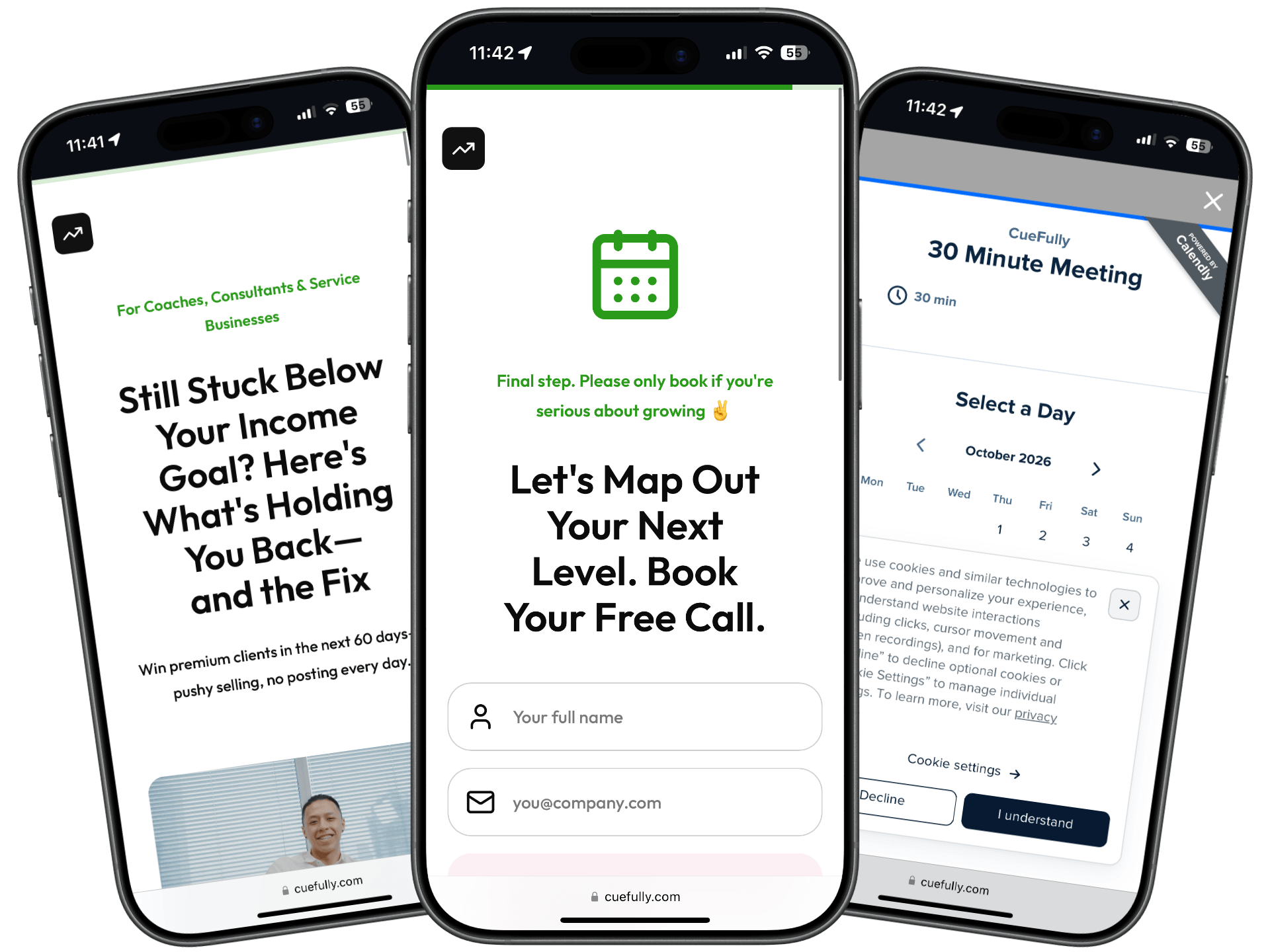
The 8-step coaching application funnel
Every step is a mobile-first wall you can edit, reorder, or rebrand for each client. Here's how this funnel is built.
- 1
Sales page
Make the case for the offer on one long page — the problem, the method, three client case studies, the program, the team and the roadmap — with a booking button after every section.
- 2
Get started
Turn the click into a short application rather than a calendar, with reviews from past clients beside the first button.
- 3
Goals
Ask what the applicant wants next, with several answers allowed, so the call can open on their priority instead of on discovery.
- 4
Client value
Ask what the applicant's own clients pay, which separates a business that can afford coaching from one that is still validating an offer.
- 5
Role
Confirm the applicant is the person who decides, so the call is not spent pitching someone who has to ask permission.
- 6
Ad budget
Ask the monthly ad spend as the last question, the strongest single signal of how ready a business is to grow.
- 7
Book a call
Collect name, email and consent, then open the Calendly or Cal.com calendar inside the funnel, with what happens on the call spelled out below.
- 8
Booked
Confirm the booking and give the applicant three things to prepare, which is what makes the call start strong.
What is a coaching application funnel?
An application funnel is a sales funnel that asks a prospect to apply before they can book a call, instead of letting anyone pick a time. It is used for high-value offers such as coaching, consulting and done-for-you services, where an unqualified call costs the seller an hour. A working application funnel has three parts: a sales page that makes the case for the offer, a short set of questions about the prospect's goals, budget and role, and a calendar booking that opens only after the answers are in. The questions do two jobs at once: they tell the seller who is worth a call, and they make the prospect state their own goal before the call begins. A coaching intake form collects similar information, but an application funnel asks it before the booking, so the calendar fills with people who already fit.
If you're planning the flow before you build it, our guide to how a booking funnel works walks through the steps this template already follows.
Tell your own client stories
Replace the three case studies, the founder section and the review grid with your real clients and results — this page sells trust before it sells a call.
Ask the questions you qualify on
Swap the four application questions for the ones your sales calls actually depend on, and add points to answers if you want a lead score to sort the calendar.
Connect your calendar
Paste your Calendly or Cal.com link into the booking step, and the visitor's name and email carry over so they only type them once.
Who it's for
Best for coaches, consultants, agencies and service businesses selling an offer that starts with a call, and the marketers who run paid traffic to those offers. It also fits any program with limited places — a mastermind, a cohort course or a done-for-you service — where reviewing an application is part of the offer.
Why it converts
The application asks for commitment in small steps — a goal, a price range, a role, a budget — so by the time the calendar opens, the prospect has already explained why they belong on it. Ad budget is the last question on purpose: it is the most revealing answer, and asking it after three easy taps keeps far more people in the funnel than asking it first.
- Every booking arrives with the applicant's goals, budget and role attached, so the call starts at the second conversation
- The calendar opens inside the funnel, not in a new tab, so the applicant never has to find their way back
- Every application lands in Contacts in real time, including the ones who never book
Frequently asked questions
More funnels
Browse the full funnel template gallery, or read our guide to building a lead generation funnel.
Launch this coaching application funnel in minutes
Customize it for your client, publish a sub-second funnel, and watch leads land in real time.
Use this funnel