Insurance Lead Generation: The Channels Compared, Meta's Ad Rules, and a Quote Funnel for Facebook and Instagram (2026)
Insurance lead generation is how agents and agencies get people who need coverage to ask for a quote. Bought vs generated leads compared, Meta's targeting rules for insurance ads, what the TCPA ruling changed, and a step-by-step mobile quote funnel.
 Faheem MushtaqCo-Founder & CTO
Summarize this article with
 ChatGPT
 Claude
 Perplexity
 Grok
Insurance lead generation is the work of getting people who need auto, home, life, health or business coverage to ask an insurance agent or agency for a quote. Agents get leads in two ways: they buy them from lead vendors and quote marketplaces, or they generate their own through referrals, local search, Google Ads and Facebook and Instagram ads. Bought leads are fast but are often shared with other agents. Generated leads take longer to set up, but each one is yours alone, and on paid social the page a shopper lands on decides whether you get a quotable household or a phone number that never picks up.
This guide compares the channels, sets out Meta's targeting rules for insurance ads, explains the 2025 TCPA consent ruling, and walks through a mobile quote funnel screen by screen. It is written for agents running their own ads and for agencies running ads for them.
Key takeaways
- Shoppers collect more quotes than ever. J.D. Power's 2026 U.S. Insurance Shopping Study, released on 4 June 2026, found auto insurance shoppers now receive an average of 3.5 quotes, the highest in the study's history.
- Nearly half of new auto policies are bought digitally. The same J.D. Power study puts digital purchases at 48% of new auto policies, up from 36% five years earlier.
- The life insurance need gap is large. The 2025 Insurance Barometer Study from LIMRA and Life Happens found 40% of Americans, about 100 million people, say they need life insurance or need more of it.
- Social media is where people research coverage. The same Barometer found 62% of adults, and 80% of those under 45, use social media to look for information on financial products such as insurance.
- Meta restricts insurance ad targeting. Insurance ads fall under Meta's Financial products and services or Housing special ad categories, which fix age at 18 to 65+, require all genders and at least a 15-mile radius, and remove lookalike audiences.
- Because targeting is broad, the funnel has to qualify. Ask the questions that decide whether an agent can quote, one per screen, before asking for a phone number.
What is insurance lead generation?
An insurance lead is a person who has asked an agent, agency or carrier to contact them about a policy. That includes a quote request, a booked call, a policy review request or a coverage calculator result they asked to receive.
Insurance lead generation splits into two approaches:
An exclusive lead is sold to one agent only. A shared lead goes to several agents at once, which turns every enquiry into a race to dial first. A live transfer is a shopper connected to you by phone while they are still on the line. Generating your own leads is the only way to be certain every lead is exclusive.
Insurance lead generation channels compared
Every channel trades intent against control. A shopper searching "car insurance quote near me" wants a quote today. A 34-year-old parent scrolling Instagram doesn't, until your ad asks whether their family would be covered if their income stopped.
Search and referrals capture demand that already exists. Paid social creates it, which is why life and final expense agents lean on Facebook and Instagram, and why those leads disappoint when the ad leads to a generic contact form.
Why so many shoppers are in play
Auto insurance shoppers compare more than ever. J.D. Power's 2026 U.S. Insurance Shopping Study surveyed 12,437 customers who requested an auto quote between January 2025 and January 2026. It found the shopping rate fell from 57% to 53% year over year, but shoppers received an average of 3.5 quotes, a record for the study.
More of that shopping happens without a phone call. J.D. Power reports that 48% of new auto policies are now purchased digitally, up from 36% five years earlier.
The shopper has several quotes open at once, so the agent who answers "what would I pay?" quickly, on a phone, has an advantage. Our speed-to-lead statistics cover what the research does and doesn't prove about responding first.
Life insurance looks different: the problem is not comparison, it is that people put it off. The 2025 Insurance Barometer Study from LIMRA and Life Happens, published on 25 June 2025, reported these figures:
That is why a life insurance ad that answers "what would this actually cost me?" can work on Instagram: the audience is there, and many of them think cover costs far more than it does.
What do insurance leads cost?
Insurance is a costly category on Google. LocaliQ's search advertising benchmarks, last updated on 1 June 2026, report these figures:
The benchmark covers Finance & Insurance as one category, not insurance alone. Bought-lead prices vary so much by line, exclusivity and vendor that no single sourced figure is worth quoting.
The number to watch is cost per bound policy, because a cheap shared lead that never answers costs more than an expensive exclusive one that binds. For cost per lead across other industries, see our average cost per lead by industry roundup.
Meta's rules for insurance ads
Insurance ads on Facebook and Instagram run under Meta's special ad categories. Jon Loomer's guide to the categories (last updated 1 March 2025) lists insurance under Financial products and services, and lists homeowners insurance and mortgage insurance under Housing.
Meta's Marketing API documentation says the Financial products and services category replaced the old Credit category in January 2025. The same page applies these restrictions to Housing, Employment and Financial products and services ads:
A final expense agent can't target over-50s, and a Medicare agent can't target people turning 65. Meta shows the ad to a broad local audience, so the funnel becomes the targeting: the questions after the click separate the household that can be quoted today from the person who tapped out of curiosity.
What the TCPA ruling changed for insurance leads
The Telephone Consumer Protection Act governs marketing calls and texts, and insurance is one of the industries most exposed to it because agents call leads quickly and often. In December 2023 the Federal Communications Commission adopted a "one-to-one consent" rule that would have limited a consumer's consent to one identified seller at a time, aimed at comparison sites that pass one consent to many buyers.
The rule never took effect. In Insurance Marketing Coalition v. FCC, decided on 24 January 2025, the U.S. Court of Appeals for the Eleventh Circuit vacated it, days before its 27 January 2025 effective date. The court held that the FCC had exceeded its authority under the TCPA.
The practical point: leads you generate yourself carry consent you wrote and collected, naming your agency, while the consent behind bought leads varies by vendor. Put consent to be contacted by phone and text on your contact screen in plain words, and have your compliance contact approve the wording. This guide isn't legal advice.
Why insurance Facebook ads produce bad leads
Insurance Facebook ads don't fail because Facebook doesn't work for agents. They fail because the page behind the ad was built for a shopper who searched, not one who scrolled.
The shopper wasn't looking for a policy. Someone who taps a "how much life insurance do you need?" ad between stories is curious, not committed. A form that asks only for name and phone collects curiosity, and the agent spends the day dialling people who don't remember submitting.
Instant forms make submitting too easy. Meta's instant forms can prefill name, email and phone from the person's account, so one tap sends a lead. That raises volume and lowers intent. Our guide to Instagram lead ads covers when an instant form is the right call and when a website funnel gets better leads.
The quote page was built for desktop. Many agency sites send ad clicks to a long quote form with a dozen fields. Zuko's 2025 industry benchmarking puts form view-to-completion at 31.3% on mobile against 37.2% on desktop. A tap in the Facebook or Instagram app opens on the phone it came from, so the mobile figure is the one that applies.
The form asks for everything up front. Date of birth, driver's licence number, vehicle VIN and current premium belong in the quoting conversation, not the first screen after an ad. Our lead form guide covers which fields cost the most completions.
Nobody calls fast enough. When a shopper is collecting three or four quotes, a lead called tomorrow has often already chosen.
How to build an insurance quote funnel for Facebook and Instagram ads
An insurance quote funnel is a short sequence of phone-sized screens that pre-qualifies a shopper before asking for contact details. It is not a full quote application. One question per screen, answered by tapping, with contact details near the end.
1. Pick one line and one offer per campaign
The offer is what the shopper gets for tapping. Match it to the ad, and run one line of business per campaign:
A coverage checklist or "how much life insurance do I need" guide is a lead magnet, not a quote offer. Our lead magnet funnel guide covers how to build one that hands warm leads to an agent later.
2. Ask the questions that decide the quote
Every question should change who calls, what they say, or whether anyone calls at all. For a term life campaign:
- Who would you want to protect? (My partner, My kids, My partner and kids, My business)
- How old are you? (Age bands)
- Do you use tobacco or nicotine? (Yes, No)
- Do you have life insurance now? (Through work only, A personal policy, None)
- How much cover are you thinking about? (Four tap ranges, plus "Not sure")
- When would you like cover in place? (As soon as possible, Within 3 months, Just researching)
Each of those is a tap. Tap-to-answer questions keep a phone visitor moving, and each answer is captured as they go, so you can see which question loses people. Our guide to multi-step forms covers why this order beats one long form.
3. Branch on readiness
A shopper who wants cover as soon as possible should see an agent's calendar. Someone "just researching" with cover through work should get a coverage guide and a follow-up sequence, not a sales call they'll ignore. Send each to a different ending.
That routing is the difference between a funnel and a form. Our lead qualification guide covers how to score answers so the readiest shoppers are called first.
4. Ask for contact details last, with clear consent
After six answers, asking for a name, email and mobile number feels like the obvious next step. Ask on one screen, say why ("so a licensed agent can send your quote"), and put the consent line naming your agency there. Then offer a calendar slot: a shopper who books a 15-minute quote review has committed more than one who typed a number.
5. Route the lead to the agent instantly
Send every submission to wherever the agent already works: a Slack channel, a shared Google Sheet, or the agency management system or insurance CRM through a webhook. The answers should arrive with the lead, so the first call opens with "you're looking for around $500,000 of cover for your partner and two kids" rather than "what can I help you with?"
6. Tell Meta which leads were good
Install the Meta Pixel and the Conversions API so Meta sees submissions that browser privacy settings would otherwise hide. Then send the conversion event for qualified leads, not every submit. Our Meta Conversions API guide covers which events a lead funnel should send. With age and lookalike targeting off the table, that conversion signal is one of the few ways left to steer who sees the ad.
Worked example: a term life quote funnel
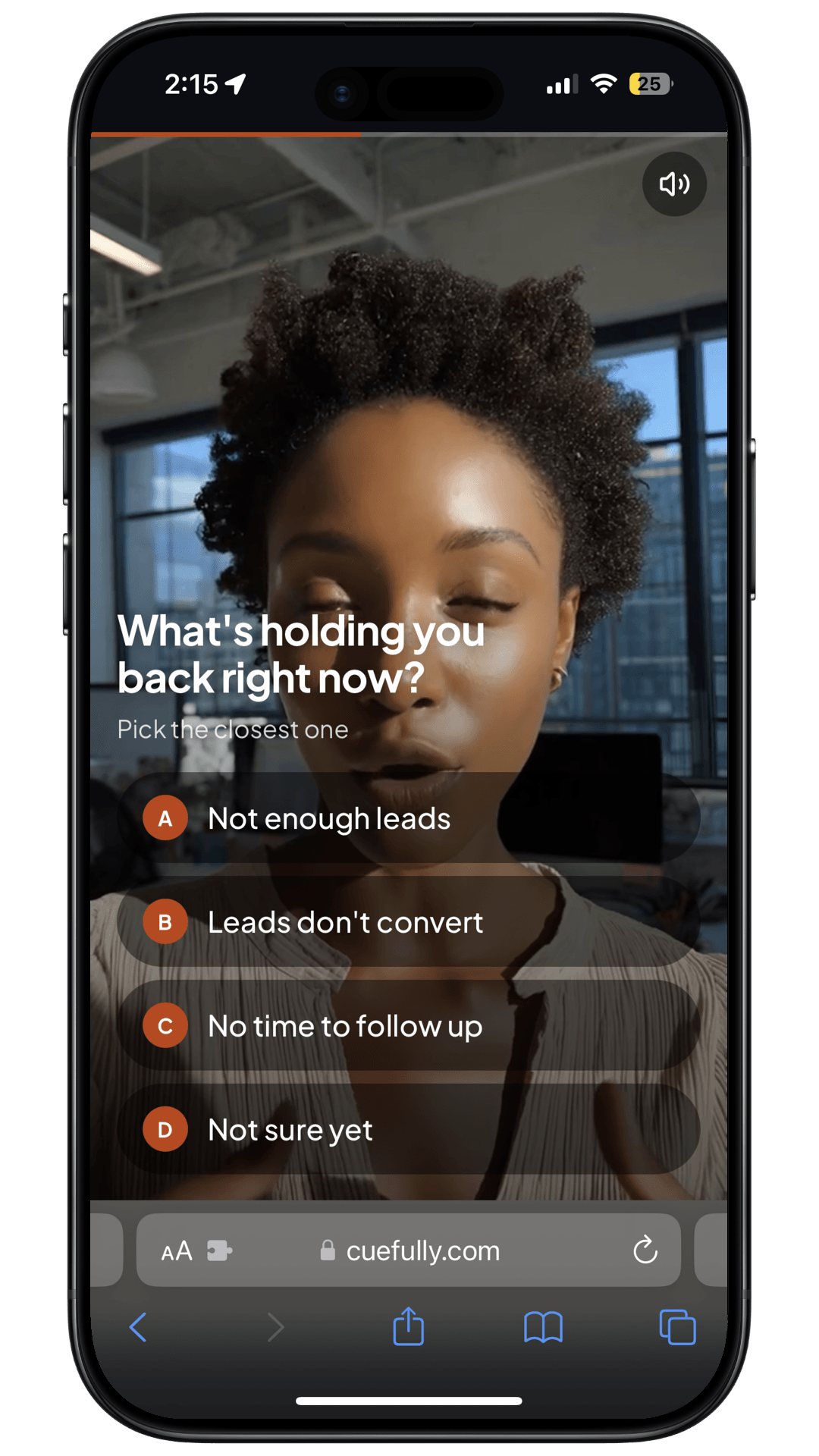
Here is a funnel for an independent agent running a term life campaign on Instagram. It is illustrative and reports no results.
The qualifying funnel that books good fits and sends everyone else a guide is this shape: a few qualifying questions, a booked call for ready leads and a free guide for early-stage ones. An agent can copy its structure and swap in the questions above. For a bundle review or annual policy review campaign, a booking page that qualifies before the calendar fits better, because the goal is a filled diary rather than a quote.
For a softer top-of-funnel campaign aimed at people not yet thinking about cover, a scored money personality quiz builds an email list of people thinking about their finances, whom an agent can nurture toward a policy review.
For an agency running ads for several insurance agents or offices, each client's funnels, leads and brand kit should live in its own workspace, so one agent's prospects never appear in another's dashboard. Our guide to choosing a funnel builder as an agency covers what to check.
How to measure insurance lead generation
Cost per lead is the number everyone reports and the one that misleads most. Track the whole chain:
Then look at drop-off per funnel step. If 40% of visitors leave on the tobacco question, the question or its wording is the problem, not the ad. Per-step analytics show which screen costs you the lead.
Frequently asked questions
What is the best way to get insurance leads? Referrals and your existing book bring the highest-quality insurance leads. To grow beyond them, combine Google search for shoppers comparing quotes now with Facebook and Instagram ads for people who aren't shopping yet, and send ad traffic to a short quote funnel that pre-qualifies before asking for a phone number.
Should I buy insurance leads or generate my own? Bought leads are fast to start but are often shared with other agents, and quality varies by vendor. Generated leads take longer to set up but are exclusive to you, with consent you collected yourself. Many agents buy leads to fill gaps and build their own channels for the long term.
Do Facebook ads work for insurance agents? Yes, when the ad sends people to a funnel that pre-qualifies them and books a call. Meta's targeting rules for insurance ads are broad, so the funnel's questions, branching and fast follow-up do the qualifying the targeting can't.
Can I target by age with insurance ads on Facebook? No. Insurance ads fall under Meta's Financial products and services or Housing special ad categories, which fix age at 18 to 65+, require all genders and at least a 15-mile radius, and remove lookalike audiences. Use the creative and the offer to attract the right age group, and let the funnel sort them.
How much do insurance leads cost? It depends on the line, the channel and whether the lead is exclusive. LocaliQ's 2026 search advertising benchmarks put the Google Ads cost per lead for Finance & Insurance at $74.44. Measure cost per bound policy rather than cost per lead.
Is the TCPA one-to-one consent rule in effect? No. The Eleventh Circuit vacated the FCC's one-to-one consent rule on 24 January 2025, before it took effect. The TCPA's existing consent requirements still apply, so collect clear consent that names your agency.
Sources and method
Sources were checked on 13 November 2026. The worked example is illustrative and reports no conversion results. This guide is not legal advice.
- J.D. Power — 2026 U.S. Insurance Shopping Study (released 4 June 2026), as published by InsuranceNewsNet — shopping rate 57% to 53%; 3.5 quotes on average, a study high; 48% of new auto policies bought digitally, up from 36% five years earlier; 12,437 customers, fielded January 2025 to January 2026.
- Life Happens — "Adults age 30 and younger overestimate life insurance cost by 10–12 times" (25 June 2025) — 2025 Insurance Barometer Study (LIMRA and Life Happens): 51% ownership among 18–75-year-olds; 40% need gap, about 100 million people; 62% of adults and 80% under 45 use social media for financial product information; 48% of Millennials cite perceived cost; 10–12 times cost overestimate.
- Meta for Developers — Special Ad Categories — Financial products and services replacing Credit in January 2025; age, gender, 15-mile radius, ZIP code and lookalike restrictions.
- Jon Loomer — "Special Ad Categories: A Guide for Meta Ads" (last updated 1 March 2025) — insurance listed under Financial products and services; homeowners insurance and mortgage insurance under Housing. A summary, not Meta's policy text.
- Morrison Foerster — "Eleventh Circuit Vacates FCC's TCPA One-to-One Consent Rule" (30 January 2025) — what the one-to-one rule would have required and the court's reasoning.
- Reed Smith — "Eleventh Circuit vacates FCC one-to-one consent rule" — decision date of 24 January 2025 and the 27 January 2025 effective date.
- LocaliQ — "Search Advertising Benchmarks" (Stephanie Heitman, last updated 1 June 2026) — Finance & Insurance cost per lead $74.44, conversion rate 2.64%, CPC $3.39, CTR 9.83%; all-industry averages.
- Zuko — "Average Conversion Rate Statistics by Industry 2025" — form view-to-completion by device: desktop 37.2%, mobile 31.3%.
- CueFully templates — the video lead qualification, appointment booking and money personality quiz funnel steps, as published on their template pages.
Sending insurance ads to a long quote form? Try a qualifying funnel on your phone — then start free with CueFully.
Build from the guide
Start with the Video Lead Qualification Funnel template
Start from a complete mobile-first flow, customize it for your client, and publish a funnel that captures qualified leads without adding developer work.