Candidate Screening Questions: Examples by Role Type
How to write screening questions that filter for genuine must-haves, examples by role type, where to place them, and the over-filtering trap to avoid.
 Faheem MushtaqCo-Founder & CTO
Summarize this article with
 ChatGPT
 Claude
 Perplexity
 Grok
GrokCandidate screening questions filter applicants against the requirements that genuinely decide whether someone can do the job — before a human spends time reading. Done well, they cut review time sharply and give candidates a faster answer. Done badly, they eliminate people who would have been excellent.
This guide covers what makes a good screening question, examples by role type, where to place them, and the mistake that quietly empties your candidate pool.
What is candidate screening?
Candidate screening is the stage between application and interview where you filter for fit. Pre-screening means doing that filtering during the application rather than after it — asking the disqualifying questions up front so unsuitable applications never reach manual review.
The distinction matters. Post-application screening costs a human reading every application. Pre-screening costs the candidate thirty extra seconds and costs you nothing.
What makes a good screening question?
One test: would a "no" here genuinely disqualify the candidate, regardless of everything else?
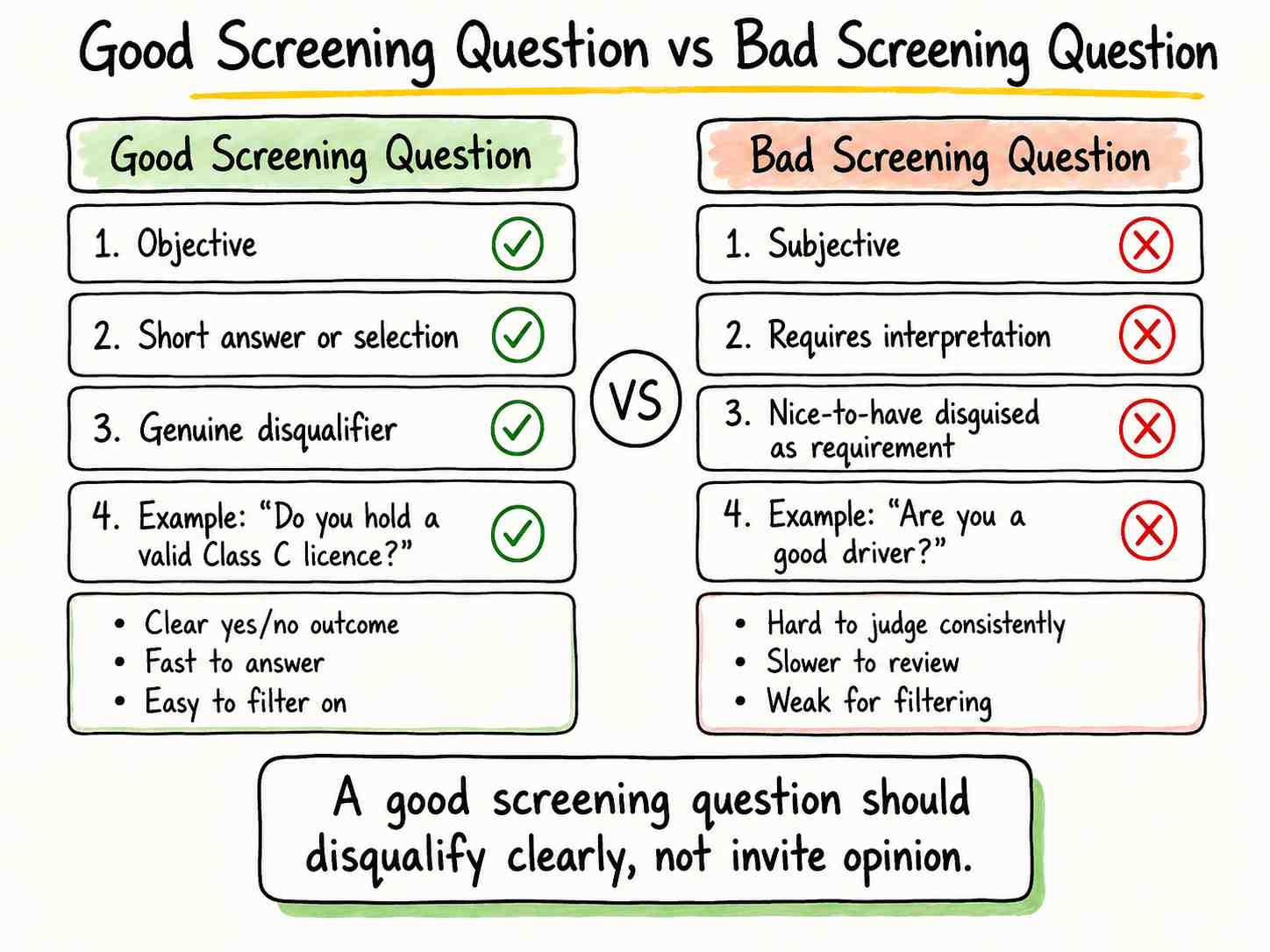
If yes, it's a screening question. If it's something you'd weigh against other factors, it belongs to human judgement and shouldn't be an automatic filter.
Good screening questions share three traits:
- Binary or near-binary. Yes/no, or a selection from a short list. Not a free-text answer someone has to interpret.
- Objective. "Do you hold a current Class C licence?" not "Are you a good driver?"
- Genuinely required. If you'd hire someone who answered wrong, it isn't a screening question.
What are good screening questions by role type?
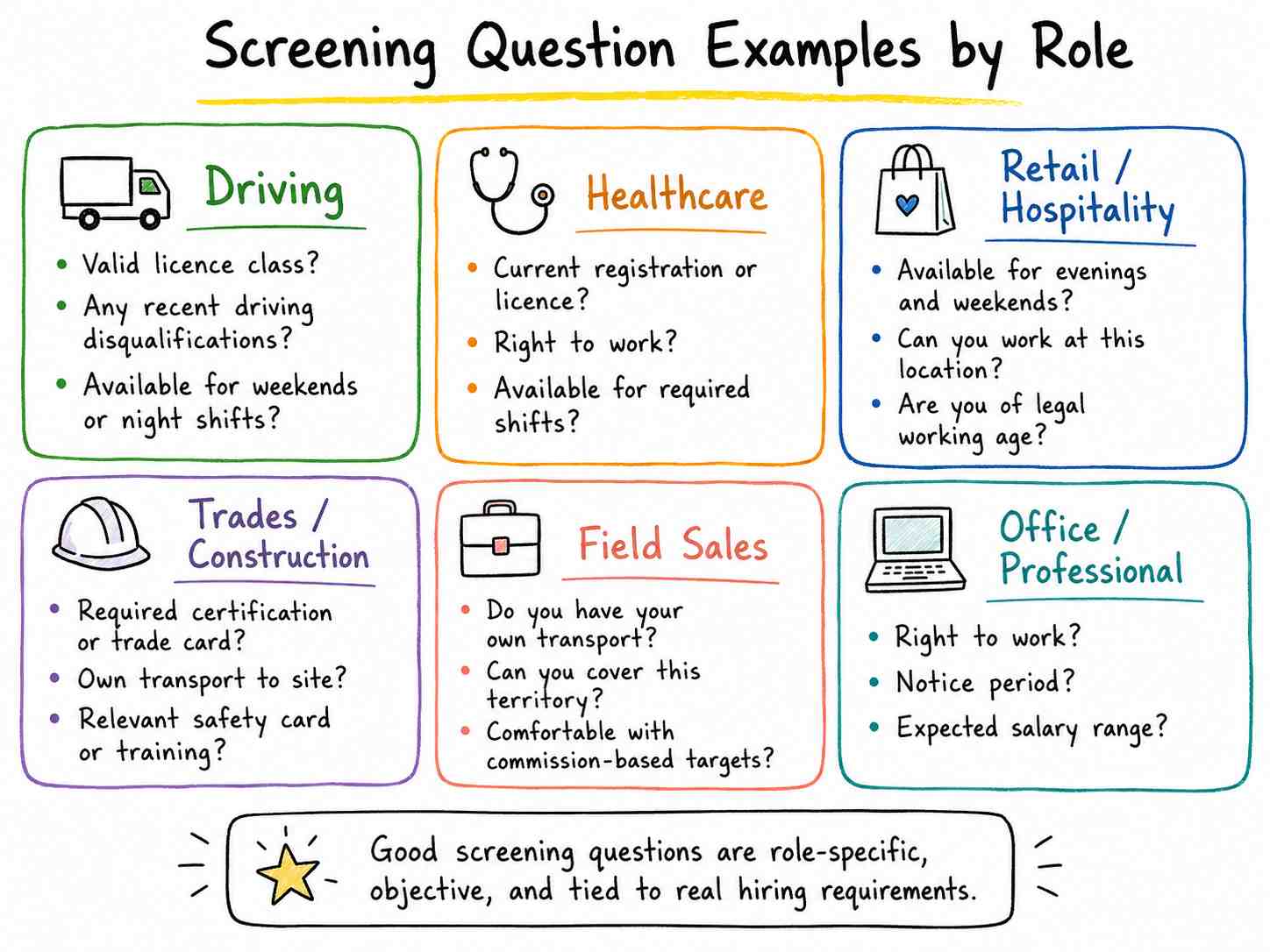
Notice what's absent: years of experience, education level, and previous job titles. These feel like screening criteria but usually aren't — they're proxies for capability that filter out career changers, self-taught candidates, and people with non-linear histories, all of whom may be exactly who you want.
Where should screening questions go?
Inside the application, in the middle.
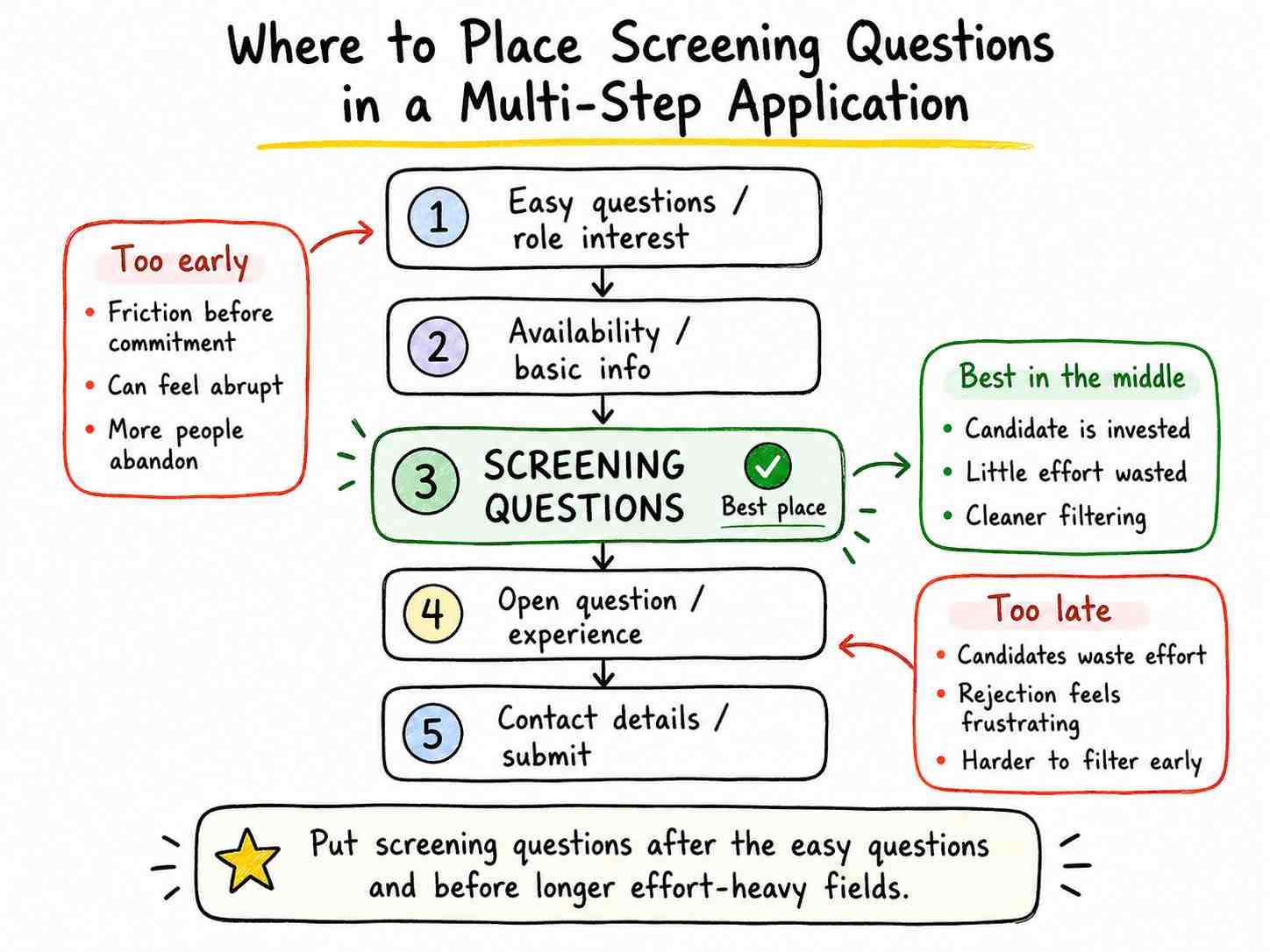
Not at the start — opening with "Do you have a licence?" reads as an interrogation before the candidate has any investment, and it front-loads friction at the point they're most likely to leave.
Not at the end — by then they've done the work and a rejection feels like wasted effort, which is precisely the experience that damages your employer reputation.
The middle works because the candidate has committed to a couple of easy steps but hasn't yet done the effortful part. A multi-step form makes this natural: the sequence becomes role and availability first, screening questions second, the open question and contact details last.
Can you over-filter with screening questions?
The most common screening failure isn't letting bad candidates through — it's the opposite.
A hiring manager lists everything they'd ideally want, each becomes a required filter, and a role with two hundred views ends up with three applicants. Each individual filter looked reasonable. Stacked, they described a person who doesn't exist.
Two guards against it:
Separate must-haves from nice-to-haves explicitly, and only screen on the first list. If the list of must-haves has more than four or five items, it's probably a wish list.
Watch your pass rate. If nearly everyone passes screening, you're not filtering enough and you've just added friction. If almost nobody does, your criteria are too tight or your job ad is attracting the wrong audience — and the fix is in the ad, not the form.
A pass rate that lets through appreciably more candidates than you can interview, but not everyone, is roughly where you want to be.
How do screening questions affect candidate experience?
A screening question is also a message about how you treat people, and it's often a candidate's first real interaction with you.
Three things make the difference:
- Explain requirements rather than just testing for them. "This role requires weekend availability" before the question tells the candidate why it's being asked.
- Respond to screened-out candidates. Silence is the most common complaint about applying for jobs, and automated screening makes silence easier. A short, prompt "not this time" costs nothing and preserves the relationship.
- Don't screen on things you haven't disclosed. If pay range, location, or shift pattern would disqualify someone, put it in the ad so they never start.
That last one is the highest-leverage change available: candidates who self-select out before applying cost you nothing and leave with a good impression.
How does screening fit the wider hiring process?
Screening is one stage of a recruitment funnel, and it's the stage most affected by the one before it. If the job application form is long and desktop-bound, your screening stage will process a smaller, worse pool no matter how good the questions are.
The recruitment funnel template puts screening in the right place by default — the role is sold first, the must-haves are asked in the middle, and the questions are meant to be rewritten for the specific job.
Frequently asked questions
What are pre-screening questions? Questions asked during the application to filter candidates against genuine requirements before manual review. They're typically binary — licences, right to work, availability, certifications — and let unsuitable applicants route out without anyone reading their application.
How many screening questions should I ask? Usually three to five. Fewer than three rarely filters meaningfully; more than five is generally a sign that preferences have crept in alongside requirements.
What is the difference between screening and interviewing? Screening tests objective requirements and can be automated. Interviewing assesses judgement, fit, and capability, and cannot. Anything requiring interpretation belongs in the interview, not the screening step.
Can screening questions be discriminatory? They can, and the risk is higher when screening is automated because the filter applies uniformly and invisibly. Restrictions on asking about age, health, family status, religion, and criminal history vary by country and region. Screen on the requirements the role genuinely has, document why each is required, and check the rules that apply where you're hiring.
Should I tell candidates they've been screened out? Yes, and promptly. Automated screening makes it trivial to send an immediate response, and silence is the most common complaint candidates have about applying. A screened-out candidate today may be a strong applicant for a different role later.
Where should screening questions go in an application form? In the middle. At the start they create friction before any investment; at the end they make rejection feel like wasted effort. After a couple of easy questions, the candidate is committed enough to answer but hasn't yet done the heavy lifting.
Ready to build one? Start free with CueFully — the mobile-first funnel builder made for agencies.
Build from the guide
Start with the Recruitment Funnel template
Start from a proven mobile-first flow, customize it for your client, and publish a funnel that captures qualified leads without adding developer work.