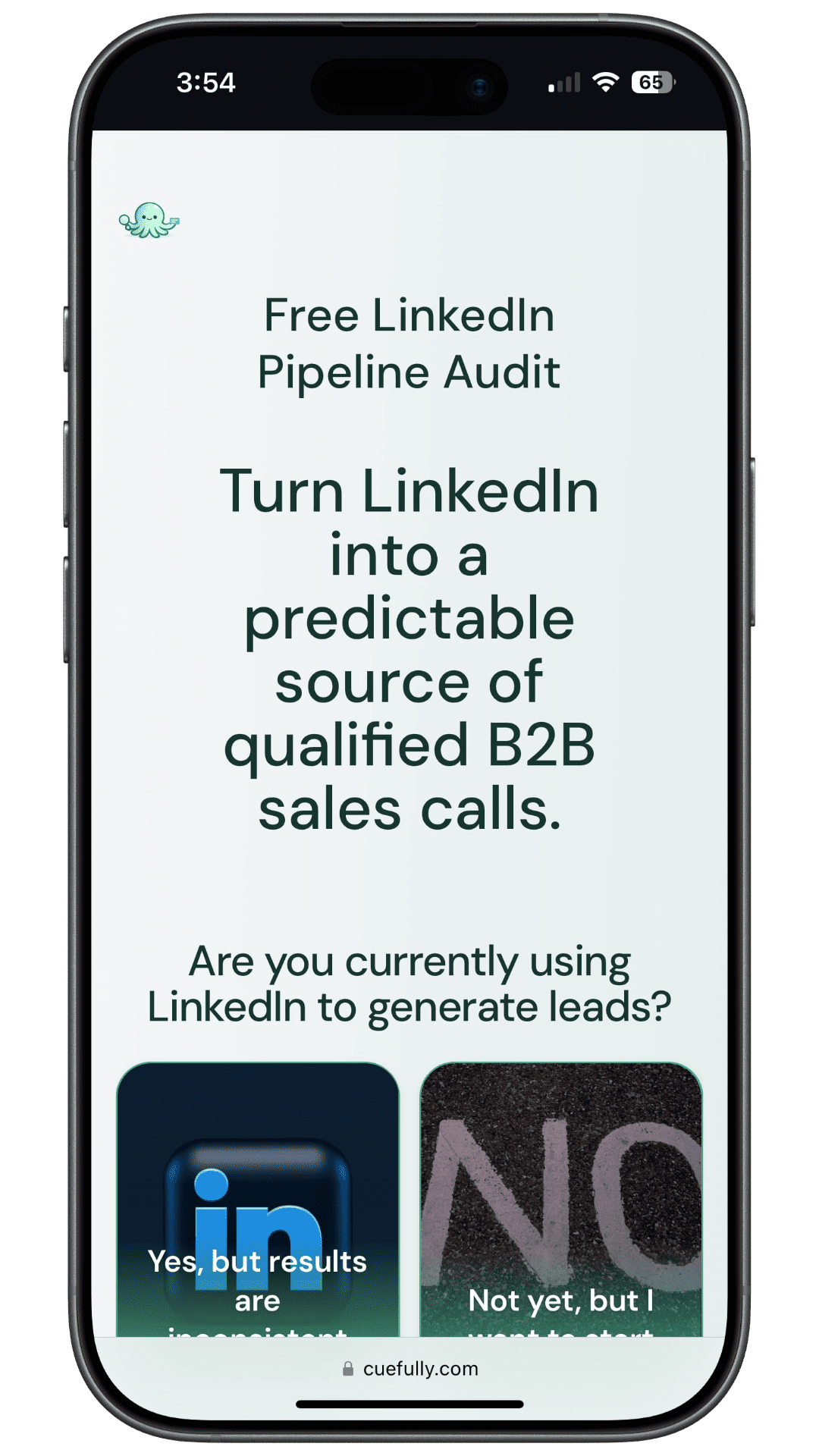
Booking Funnel: How to Build One That Fills Your Calendar (2026)
What a booking funnel is, how it differs from a booking page, the 6 steps to build one that qualifies before it books, and how agencies run it across every client.
 Faheem MushtaqCo-Founder & CTO
Summarize this article with
 ChatGPT
 Claude
 Perplexity
 Grok
GrokA booking funnel is a short, multi-step flow that takes someone from an ad click to a confirmed appointment, asking a few qualifying questions along the way so that only good-fit prospects reach your calendar. It replaces the single "here's my calendar" page with a sequence that filters first and books second.
That distinction is the whole point. A booking page maximizes the number of slots taken. A booking funnel maximizes the number of slots worth taking. If your sales team is sitting through calls with people who were never going to buy, you have a booking page problem.
What is a booking funnel?
A booking funnel is a mobile-first sequence of short steps that presents your offer, qualifies the visitor, captures their details, and books the appointment, all in one flow. Each step asks for one small commitment, which is easier to say yes to than a long form, so more of the right people finish.
The three jobs it performs, in order:
- Present — make the offer concrete enough that a poor-fit visitor self-selects out.
- Qualify — ask the two or three questions that separate a real prospect from a tire-kicker.
- Book — capture contact details and lock the slot while intent is highest.
Booking funnel vs. booking page: what's the difference?
A booking page shows a calendar and hopes the visitor is a good fit. A booking funnel asks qualifying questions before the calendar appears, so poor-fit prospects drop out before they take a slot. The result is usually fewer bookings and more revenue.
| Booking page | Booking funnel | |
|---|---|---|
| Structure | One page, one calendar | Short multi-step flow |
| Qualification | None, or a form field nobody reads | Built into the steps |
| Typical outcome | More bookings, more no-shows | Fewer bookings, better fit |
| Mobile experience | Calendar widget on a phone | Designed for the phone first |
| What you learn | Name and email | Budget, timeline, intent, source |
If you want the ready-made version of this, our booking page template is built exactly this way: offer, qualifying questions, then the booking step.
How to build a booking funnel in 6 steps
Step 1 — Define the appointment worth having
Write down what a qualified appointment actually looks like: the role, the budget range, the timeline, the problem. Everything downstream exists to attract that person and screen out everyone else. Skip this and you will optimize for volume and bury your sales team.
Step 2 — Lead with the offer, not the calendar
The first screen should make the value of the call obvious: what the prospect walks away with, and why it is worth 30 minutes. A calendar shown too early converts curiosity into a wasted slot.
Step 3 — Ask two or three qualifying questions
Pick the smallest set of questions that separates good fit from bad: budget, timeline, company size, current tooling. Order them easiest to most sensitive. Where an answer changes what should happen next, branch so each visitor only sees relevant steps.
Step 4 — Build it mobile-first
Most of this traffic arrives from an ad, on a phone. Keep steps short, touch targets large, and load times fast. A funnel that renders in under a second holds the attention a slow calendar widget loses.
Step 5 — Book, confirm, and reduce the no-show
Capture name, email, and phone, then confirm clearly what happens next. Send a reminder before the call. A confirmed appointment that nobody attends is not a conversion.
Step 6 — Read the drop-off and fix the weakest step
Watch where people leave, step by step. When one question loses a disproportionate share, it is almost always asked before the visitor is willing to answer it — availability and phone number are the usual culprits. Move it later, republish, and compare.
Should you gate the booking behind a lead magnet?
Sometimes. If your offer needs warming up, trading something genuinely useful for contact details first, then qualifying, then booking, tends to produce better-fit calls than asking a cold visitor to book immediately. That pattern is a lead magnet funnel, and it works well when the buyer needs a reason to trust you before giving up a slot in their week.
Lead with the calendar when intent is already high (branded search, a warm referral, a retargeting audience). Lead with a lead magnet when the traffic is cold.
How do agencies run booking funnels across many clients?
Agencies win by treating the six steps above as one repeatable process, then reusing it per client instead of rebuilding from zero. Practically, that requires:
| Need | Why it matters |
|---|---|
| A workspace per client | Funnels, leads, and branding stay isolated |
| Reusable brand kits | Each client's fonts and colors applied in one click |
| Templates | Start from a proven flow, not a blank canvas |
| Real-time lead visibility | Show clients bookings landing live |
| Per-source analytics | Prove which campaigns produced qualified appointments |
This is the model CueFully is built around, and why the funnel templates are designed to be duplicated and rebranded per client rather than used once.
Common booking funnel mistakes
- Showing the calendar first — you get slots taken by people who should never have booked.
- Asking too much, too early — sensitive questions before any value is delivered kill completion.
- Treating a booking as the finish line — no reminder, no confirmation, high no-show rate.
- Desktop-first design — the ad click is on a phone; the funnel has to be too.
- Never reading drop-off — you cannot fix a step you do not measure.
Frequently asked questions
What is a booking funnel? A booking funnel is a short multi-step flow that takes someone from an ad click to a confirmed appointment, qualifying them with a few questions along the way so only good-fit prospects reach your calendar.
How is a booking funnel different from a booking page? A booking page shows a calendar immediately and optimizes for the number of slots taken. A booking funnel qualifies first, so it usually produces fewer but far better appointments.
How many steps should a booking funnel have? Enough to qualify, few enough to finish. Most work well between four and eight short steps: offer, two or three qualifying questions, contact details, then the booking.
Do booking funnels reduce no-shows? They help, because a prospect who has answered qualifying questions is more invested than one who clicked a calendar link. Pairing that with a clear confirmation and a reminder before the call reduces no-shows further.
Can I build a booking funnel without code? Yes. The build is visual end to end — add steps, edit copy directly on the canvas, publish. Starting from a booking page template removes most of that work again.
Want a booking funnel that qualifies before it books? Start free with CueFully — no credit card required.
Build from the guide
Start with the Appointment Booking template
Start from a proven mobile-first flow, customize it for your client, and publish a funnel that captures qualified leads without adding developer work.