Web-to-App Funnel: How Web2App Works and How to Build One (2026)
A web-to-app funnel moves a subscription app's onboarding quiz and paywall onto the mobile web, between the ad and the App Store. How web2app works, the fee maths against Apple and Google, the seven steps to build one, and the trade-offs nobody puts on the sales page.
 Faheem MushtaqCo-Founder & CTO
Summarize this article with
 ChatGPT
 Claude
 Perplexity
 Grok
A web-to-app funnel (often written web2app) is a mobile web flow that sits between a paid ad and an app install. The visitor answers an onboarding quiz, sees a plan built from their answers, and subscribes or starts a free trial on a web paywall. Only then do they download the app and sign in with the email they gave in the funnel.
Subscription apps use web-to-app funnels for three reasons. A payment taken on the web is not subject to the App Store or Google Play commission. The ad platform sees the trial or subscription directly from the web, instead of guessing from installs. And the onboarding, the offer and the price can change the same day, with no app update and no app review.
Every fee and benchmark below was checked at the source on 15 November 2026.
Key takeaways
- A web-to-app funnel runs onboarding and checkout on the web before the install. The usual shape is ad, quiz, personal plan, email, paywall, then the app download.
- The store commission is the headline reason. Apple keeps 30% of a subscription's price in a subscriber's first year and 15% after that, or 15% throughout for developers in its Small Business Program, according to Apple's developer documentation.
- Google Play's subscription fee has dropped in some markets. Google's Play Console Help lists 10% plus a 5% billing fee, where it applies, for auto-renewing subscriptions in the US, UK, EEA, Japan and Australia, and 15% in other markets.
- Attribution is the second reason. Since iOS 14.5, apps need permission through Apple's App Tracking Transparency prompt to track users; a web funnel reports the trial or subscription to Meta from the web instead.
- The paywall model matters more than the paywall design. RevenueCat's 2026 report put median Day-35 conversion at 10.7% for hard-paywall apps against 2.1% for freemium apps.
- The web adds work. You take on payments, sales tax, refunds and an extra install step.
What is a web-to-app funnel?
A web-to-app funnel is an app's onboarding and paywall, rebuilt as a mobile web page and placed in front of the app store. The ad sends people to the funnel URL instead of the App Store or Google Play listing. The funnel does the selling; the app delivers what was sold.
GoPractice, in its October 2024 guide to web funnels for mobile apps, separates two versions of the idea:
Most teams now say "web2app" for both and mean the second: the subscription is bought on the web. That is the version this guide covers. It is a close relative of the quiz funnel; only the last screen differs. A lead-gen quiz ends with an email form, and a web-to-app quiz ends with a paywall.
Why do subscription apps move onboarding to the web?
1. The store commission
Apple's subscription terms are set out on its developer site. During a subscriber's first year, the developer receives 70% of the subscription price at each billing cycle; after one year of paid service, that rises to 85%. Free trials do not count toward the year. Developers enrolled in the App Store Small Business Program, which Apple announced on 18 November 2020 for developers with up to $1 million in proceeds the previous calendar year, receive 85% from the first payment.
Google Play changed its rates in 2026. Google's Play Console Help lists a 10% fee plus a 5% billing fee, where applicable, for auto-renewing subscriptions in Australia, the EEA, Japan, the UK and the US, on the first $1 million of annual earnings. Other markets stay at 15% until the new fees roll out.
On the web, the cost is the payment processor's. Stripe's US pricing page lists 2.9% + 30¢ per successful domestic card payment, and Stripe Billing's pay-as-you-go plan adds 0.7% of billing volume.
Here is what that means for one $59.99 annual subscription in its first year, sold to a US subscriber:
The gap is largest against Apple's standard rate and smallest against Google Play's new US rate.
2. Attribution after App Tracking Transparency
Apple's developer documentation says that in iOS 14.5 and later, an app needs the user's permission through the App Tracking Transparency framework to track them or read the device's advertising identifier. Without permission, the identifier is all zeros, and the ad platform gets a thin picture of who installed and who paid.
A web funnel keeps the click on the web, where the Meta Pixel and the Conversions API can report what happened. Meta's standard events reference defines StartTrial as "when a person starts a free trial of a product or service you offer," and Subscribe for a paid subscription. Both accept a value and a predicted_ltv parameter, so campaigns can optimise toward people who pay rather than people who install.
3. Speed of change
Every change to in-app onboarding ships in an app update and waits for review. A web funnel changes when you publish it, so a new first question or a different trial length can go live the same afternoon.
4. The email from day one
Every web subscriber gives an email before they pay: the address for the receipt, the sign-in, and the follow-up if they never open the app.
How a web-to-app funnel works, step by step
The order is deliberate. The plan comes before the email, and the email comes before the paywall, so a visitor who leaves at the price is still a contact.
A worked example: a 34-screen onboarding quiz
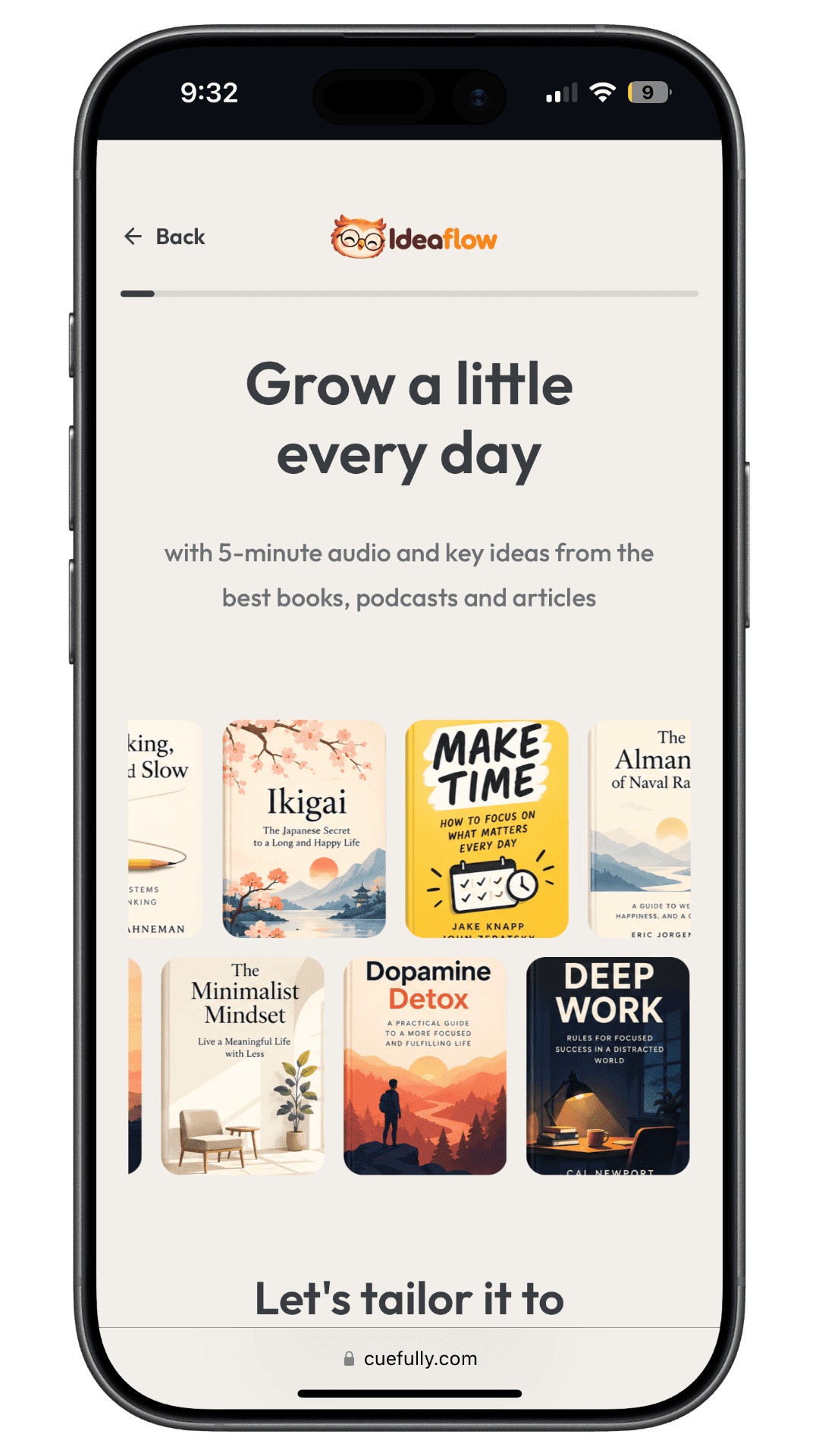
CueFully's web2app onboarding quiz template is built for a learning or self-improvement app, and it follows the table above. It runs 34 screens, grouped into ten steps:
- Hook: one screen about the habit the app replaces, with a single Continue button.
- Content preview: drifting rows of book covers, with the first question underneath.
- Profile: age on picture cards and topics as a multi-select.
- Personality: how the visitor learns, including six agree-or-disagree statements.
- Personalise: favourite thinkers, books and minutes a day.
- Building the plan: three stages, pausing for three yes-or-no questions.
- Email: the address that saves the plan and receives the receipt.
- Plan ready: a projection of the first month.
- Paywall: three plans with card checkout, plus Apple Pay and Google Pay where supported.
- Welcome: App Store and Google Play buttons and a reminder to sign in with the same email.
Thirty-four screens sounds long, but every screen is one tap, and the paywall offers a plan the visitor has just watched being built. For a fitness-style version, the Wall Pilates challenge funnel runs the same pattern with photo-card answers and a 28-day plan.
How to build a web-to-app funnel in 7 steps
Step 1: Decide how the app recognises a web subscriber
Settle this before you design a screen. The subscription is created in your payment provider under the email from the funnel, and your backend grants access when that email signs in to the app. Most teams keep the backend current with the payment provider's webhooks for started, renewed and ended subscriptions. Without this, a paying subscriber opens the app and meets the in-app paywall again.
Step 2: Write the quiz from what the app really personalises
Ask the questions your app actually uses to set up the experience; if the plan does not change with the answers, visitors notice. Keep every answer a tap. Our guide to multi-step forms covers why one question per screen holds people better on a phone.
Step 3: Ask for the email before the price
Put the email screen after the plan and before the paywall, framed as saving the plan. You keep a contact even if they leave at the price.
Step 4: Choose the paywall model and the trial length
Decide whether the funnel is a hard paywall, where nothing is usable without a subscription or trial, or a softer entry. RevenueCat's State of Subscription Apps report, published on 19 March 2026 and covering more than 115,000 apps, put median Day-35 conversion at 10.7% for hard-paywall apps and 2.1% for freemium apps.
Trial length is the next decision. The same RevenueCat report found trials of 17 to 32 days converted at a median 42.5%, against 25.5% for trials under four days. It also found that 55.4% of all three-day trial cancellations happened on the day the trial started. A three-day trial is not automatically wrong, but its cancellations come fast, so the plan has to land on day one.
On the paywall, state the price, billing period, trial end date and first charge date in plain words.
Step 5: Make cancelling easy
Send every subscriber a confirmation email with the plan, the price, the trial end date and a manage link, and give them a page where cancelling is a button. A subscriber who cannot find the exit tends to find their bank's dispute form instead.
Step 6: Send the right events to the ad platform
Send StartTrial when a free trial begins, Subscribe when a paid subscription starts, and Purchase for one-time plans, each with its value. Send them from the server through the Conversions API as well as from the browser pixel, with a shared event ID so Meta counts each once. Our Conversions API guide covers deduplication and Event Match Quality step by step.
Step 7: Read the drop-off per screen
A 34-screen funnel needs per-screen numbers: find the screen that loses the most people, change it, and publish. The form abandonment statistics we track show how much a single badly placed question can cost.
What a web-to-app funnel costs you
The fee table is the sales pitch. These are the parts that come with it:
- An extra step before the app. The visitor pays, then has to install the app. A subscriber who never installs is a likely refund request, so the welcome screen and first email both point to the store.
- Sales tax and VAT. The stores collect and remit tax on in-app purchases. On the web, that is your job, or the job of a merchant-of-record service that charges for it.
- Payment operations. Refunds, failed renewals and chargebacks land with you instead of Apple or Google.
- Entitlement syncing. The app and the payment provider have to agree on who is subscribed, including after cancellations and plan changes.
- Rules that are still moving. A US court found on 30 April 2025 that Apple had violated an anti-steering injunction on links from apps to web checkouts, and in December 2025 the Ninth Circuit allowed Apple to seek a commission limited to its genuine costs. A web-to-app funnel takes payment before the install, so it does not rely on in-app links, but the rules around it are not settled.
None of these is a reason not to build one. They are why a web-to-app funnel is a project, not a page.
Which apps fit a web-to-app funnel?
Apps that personalise fit best, because the quiz has something real to build. GoPractice's interview with FunnelFox's CEO names health and fitness, horoscopes, fashion and education as the strongest categories, and games and utilities as harder fits. That is one practitioner's view, not a measured ranking. Apps without a subscription gain little, because the funnel exists to sell the subscription before the store does.
What to look for in a web-to-app funnel builder
CueFully is a mobile-first funnel builder, and web2app is one of the three jobs it is built for. Disclosure: this is our product, judged on the criteria above. Recurring plans with free trials bill through your own Stripe account, StartTrial and Subscribe reach Meta through the Pixel and Conversions API as one integration, and every subscriber gets a confirmation email and a page to cancel or resume. Its limits are worth knowing before you choose it: CueFully does not sync with RevenueCat or app store receipts, and it does not do deep links or install attribution, so your backend grants access by checking Stripe for the subscriber's email. The web2app funnels page shows the whole flow on real screens.
Frequently asked questions
What is a web-to-app funnel? A web-to-app funnel is a mobile web flow that onboards and sells a subscription before the app is installed. The visitor answers a quiz, sees a personal plan, pays or starts a trial on a web paywall, then downloads the app and signs in with the same email.
What is the difference between Web2App and Web2Web? In GoPractice's definition, Web2App sends the visitor from web onboarding into the app to buy through the store, while Web2Web takes the payment on the web before the install. Most teams now say "web2app" for both.
How much does a web-to-app funnel save on app store fees? It depends on the store and your size. On a $59.99 annual plan in its first year, Apple's standard 30% is $18.00, while a US Stripe card payment plus Stripe Billing comes to about $2.46. Against Apple's Small Business Program or Google Play's new US rate, the saving is smaller.
How does the app know someone subscribed on the web? The subscription is stored in your payment provider under the email from the funnel. When the subscriber signs in to the app, your backend checks that email, usually kept up to date by the payment provider's webhooks, and unlocks access.
Which events should a web-to-app funnel send to Meta? StartTrial when a free trial begins, Subscribe when a paid subscription starts and Purchase for one-time plans, each with a value. Meta's standard events reference defines all three.
Sources and method
Sources were checked on 15 November 2026. The fee table is arithmetic on the published rates, not a measured CueFully result. It excludes taxes, refunds and currency conversion.
- Apple Developer — Auto-renewable subscriptions — 70% net revenue in a subscriber's first year, 85% after one year of paid service, free trials excluded, 85% throughout for Small Business Program members.
- Apple Newsroom — "Apple announces App Store Small Business Program", 18 November 2020 — 15% commission for developers with up to $1 million in proceeds in the previous calendar year.
- Google Play Console Help — Service fees — 10% plus a 5% billing fee where applicable for auto-renewing subscriptions in Australia, the EEA, Japan, the UK and the US; 15% in other markets until the new fees roll out.
- Stripe — Pricing — 2.9% + 30¢ per successful domestic card transaction in the US; Stripe Billing pay-as-you-go at 0.7% of billing volume.
- Apple Developer — User privacy and data use — App Tracking Transparency permission required to track users or access the advertising identifier in iOS 14.5 and later.
- Meta for Developers — Meta Pixel standard events reference — definitions and parameters for StartTrial, Subscribe and Purchase.
- RevenueCat — Subscription app trends and benchmarks 2026, 19 March 2026 — more than 115,000 apps; median Day-35 conversion of 10.7% for hard paywalls and 2.1% for freemium; 42.5% vs 25.5% median trial conversion for 17–32 day vs under-4-day trials; 55.4% of three-day trial cancellations on Day 0.
- GoPractice — "Web funnels for mobile apps: a guide", October 2024 — the Web2App and Web2Web distinction; categories named as strong and weak fits by FunnelFox's CEO.
- MacRumors — Apple ordered to comply with App Store anti-steering injunction, 30 April 2025 — the April 2025 finding against Apple.
- Fenwick — "Ninth Circuit Largely Upholds Ruling in Epic v. Apple", 22 December 2025 — the Ninth Circuit's December 2025 ruling allowing a commission limited to Apple's genuine costs, remanded to the district court.
- CueFully web2app quiz funnel template — screen count, step order and paywall contents, as published on the template page.
Selling an app subscription to phones that never reach the store? Take the web2app quiz on your phone, then start free with CueFully.
Build from the guide
Start with the Web2App Quiz Funnel template
Start from a complete mobile-first flow, customize it for your client, and publish a funnel that captures qualified leads without adding developer work.