Home valuation landing page that ends in a listing appointment
Six questions about the house, an estimated range the homeowner can check against recent sales, and a site visit booked while the number is still on screen.
Opens in CueFully · free to start, no credit card
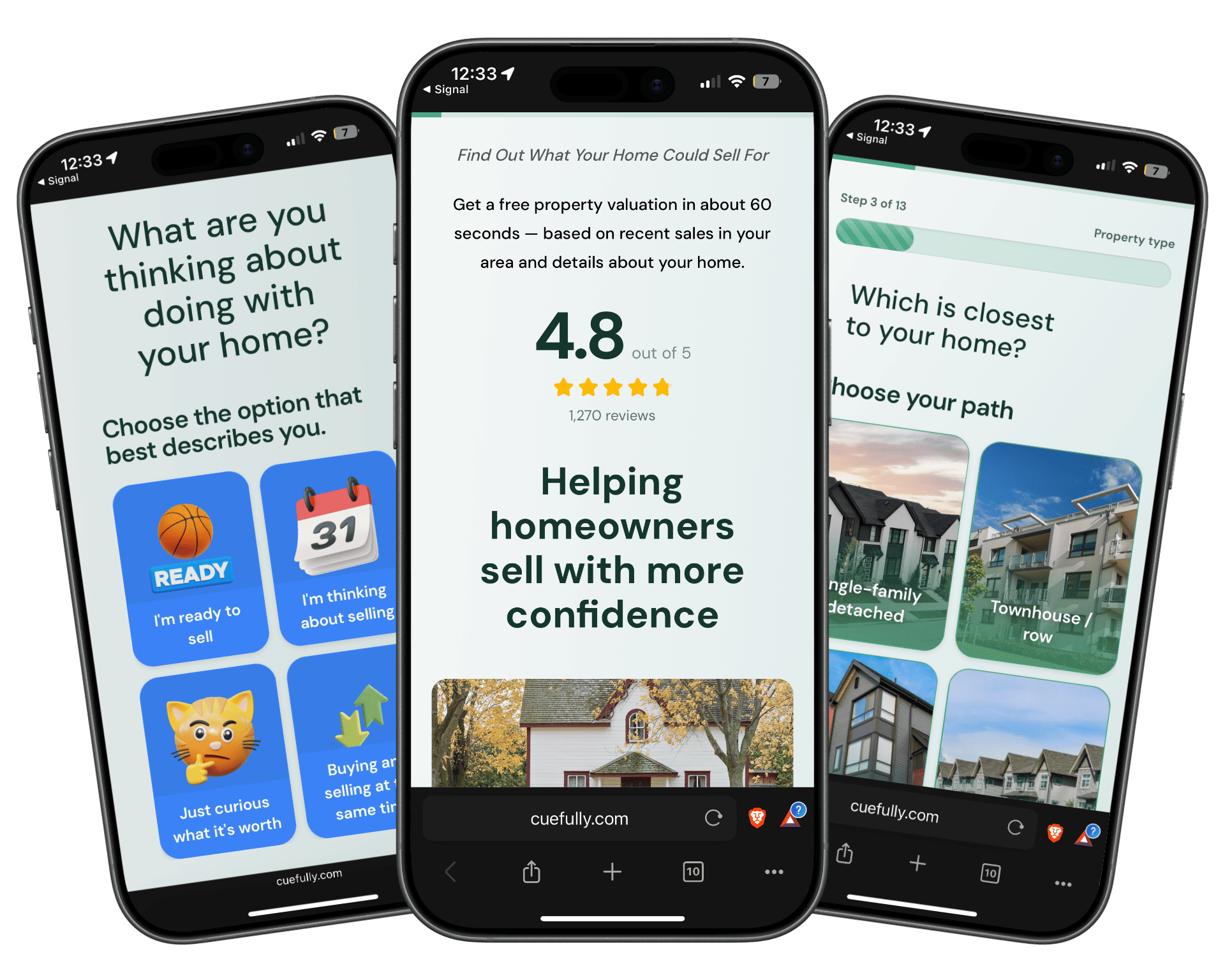
The 13-step home valuation funnel
Every step is a mobile-first wall you can edit, reorder, or rebrand for each client. Here's how this funnel is built.
- 1
Valuation promise
Open on what the homeowner actually wants to know — what the house would sell for — and price the answer at six questions, not a phone call.
- 2
Why now
Separate the homeowner who is curious from the one who is moving, on the first tap, before any personal detail is asked for.
- 3
Property type
Establish the kind of home being valued, so the range that comes back is comparable to something real.
- 4
Concerns
Surface what is making the sale feel complicated — the objection the agent will have to answer on the visit anyway.
- 5
Size
Take square footage on a slider with 'close enough is fine', because an exact number is a reason to abandon and an approximate one values the house just as well.
- 6
Timing
Ask when they would move if the number is right — the single answer that sorts a live listing from a lead to nurture.
- 7
Condition
Capture condition in the homeowner's own words, which is what moves a house inside its price band.
- 8
Analysis
Show the estimate being assembled — recent sales nearby, homes like theirs, the range — so the number arrives as work rather than as a pop-up.
- 9
Result and capture
Show the estimated range on screen first, then ask where to send the full breakdown and the comparable sales.
- 10
Offer · Book the visit
Offer to confirm the number in person for movers, with the calendar in the funnel — twenty minutes, framed as verification rather than a pitch.
- 11
Result · Worth preparing
Give the not-yet-ready homeowner the same range plus what it could be after prep, which is the reason they come back.
- 12
Offer · Market report
Close the email-only branch on the breakdown being sent, so a lead who is not booking today still leaves as a contact.
- 13
Booking confirmed
Confirm the visit by name and set expectations for what happens in those twenty minutes.
What is a home valuation funnel?
A home valuation landing page is a page that offers a homeowner an estimate of what their property is worth in exchange for details about the property and a way to contact them. The weak version is a form with an address field: the visitor types an address, and a number arrives by email that they cannot check. The version that produces listings asks a handful of questions the homeowner can answer from memory — why they are thinking about value, the type and size of the home, its condition, and when they would move — then shows an estimated range on screen, explains what it is based on, and asks for the email to send the full breakdown and the comparable sales. The questions are what make the estimate credible, and they are the same answers that tell an agent whether this is a listing appointment or a contact to nurture.
If you're planning the flow before you build it, our guide to how a quiz funnel works walks through the steps this template already follows.
Put your market in the range
Replace the estimate copy and the projection figures with your own bands, and rewrite the basis line to name the area you actually pull comparables from.
Route on timing, not on everything
Send the movers to the calendar and everyone else to the market-report branch, so the booking offer stays scarce and the nurture list still grows.
Swap in your own proof
Replace the reviews, the agent card, and the sold-in-11-days quote with your own results — this funnel is asking for a house, and generic proof reads as a lead-gen page.
Who it's for
Best for real estate agents, teams, and brokerages running paid or local traffic to seller-lead offers, and the marketers who build those campaigns for them. It also fits anyone valuing an asset a person owns and is thinking of selling — land, a business, a vehicle — where the estimate is the reason to fill anything in at all.
Why it converts
The estimate appears on screen before the email is asked for, so the homeowner is deciding whether to receive the breakdown, not whether to gamble their address on a number they may never see. Timing and condition are asked before the result, which means the booking offer on the next screen is shown only to the people whose answers earned it.
- The homeowner sees the range before handing over an email, so the ask is for delivery, not for access
- Timing and condition are captured before the booking offer, so the calendar fills with sellers rather than browsers
- Every answer, estimate, and booking lands in Contacts with no per-lead fees
Frequently asked questions
More funnels
Browse the full funnel template gallery, or read our guide to building a lead generation funnel.
Launch this home valuation funnel in minutes
Customize it for your client, publish a sub-second funnel, and watch leads land in real time.
Use this funnel