How to Build a Lead Magnet Funnel That Qualifies (2026)
A step-by-step guide to building a lead magnet funnel: why most fail after the download, the 6 steps to qualify as you convert, which lead magnets work, and how to build one without a developer.
 Faheem MushtaqCo-Founder & CTO
Summarize this article with
 ChatGPT
 Claude
 Perplexity
 Grok
GrokA lead magnet funnel is a short, multi-step flow that trades something genuinely useful — a checklist, template, calculator, or guide — for contact details, then keeps qualifying the visitor across the steps that follow. The download is the entry point, not the destination.
That last part is where most of them break. Teams spend weeks designing a beautiful ebook, ship it behind a form, and count the opt-ins. The asset is maybe 10% of the work. The other 90% is what happens between "thanks for downloading" and a sales conversation.
What is a lead magnet funnel?
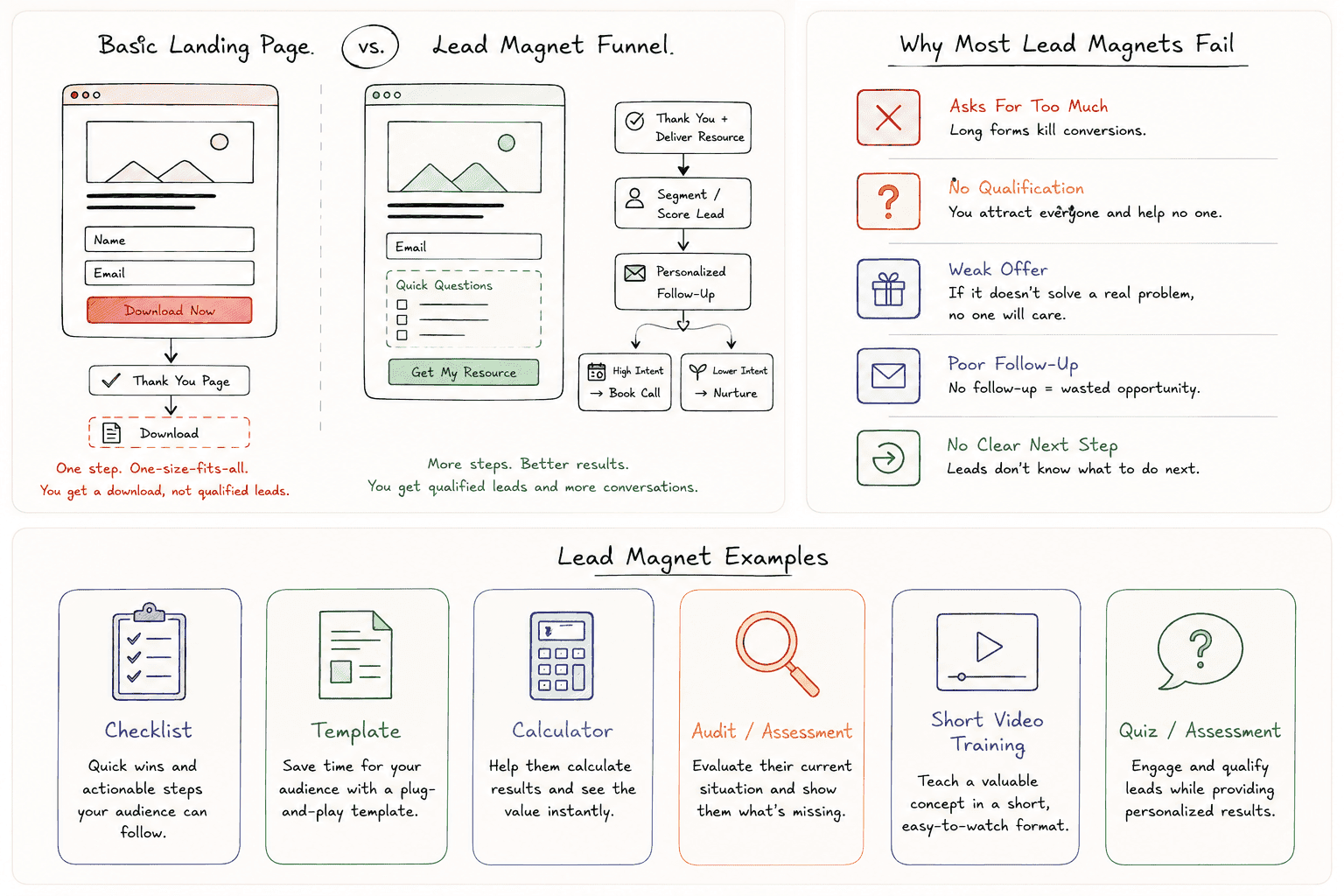
A lead magnet funnel is a sequence that attracts the right person with a free resource, captures their details, qualifies them with a few short questions, and routes them to a next step — a call, a demo, or a nurture sequence. Unlike a static lead magnet landing page, which stops at the download, a funnel keeps working after the opt-in.
It is one shape of lead generation funnel: the version that leads with a free resource rather than an offer or a booking. If you are choosing between approaches, that guide covers the wider set.
The four jobs it performs, in order:
- Attract — an offer specific enough that the wrong people ignore it.
- Capture — contact details, asked for at the moment perceived value is highest.
- Qualify — two or three questions that separate a buyer from a browser.
- Route — send qualified leads toward a conversation, and everyone else to nurture.
In classic funnel terms, the magnet sits at the top and the funnel carries the lead down:
| Stage | What happens |
|---|---|
| Top (awareness) | The lead magnet earns attention and the opt-in |
| Middle (consideration) | Qualifying steps and follow-up build context and trust |
| Bottom (decision) | A call, demo, or trial converts the qualified lead |
Most teams build the top and skip the middle. The middle is where the qualification happens, and it is the part that decides whether the bottom is worth anything.
What are the components of a lead magnet funnel?
Six pieces, each with one job:
| Component | Its job |
|---|---|
| The magnet | A resource that solves one real, urgent problem |
| The landing page or first step | Makes the value obvious in one screen, no distractions |
| The opt-in | Captures the minimum needed to follow up |
| Qualifying steps | Two or three questions that grade the lead |
| Delivery and follow-up | Instant delivery, then a sequence that keeps the conversation going |
| The conversion offer | The call, demo, or trial the whole funnel points at |
Lead magnet funnel vs. lead magnet landing page
A lead magnet landing page has one job: get the download. A lead magnet funnel treats the download as step one and keeps qualifying afterwards. The page optimizes for opt-in rate; the funnel optimizes for qualified conversations. You can see the difference concretely in our lead generation landing page examples, where the checklist funnel keeps qualifying for seven steps after the opt-in.
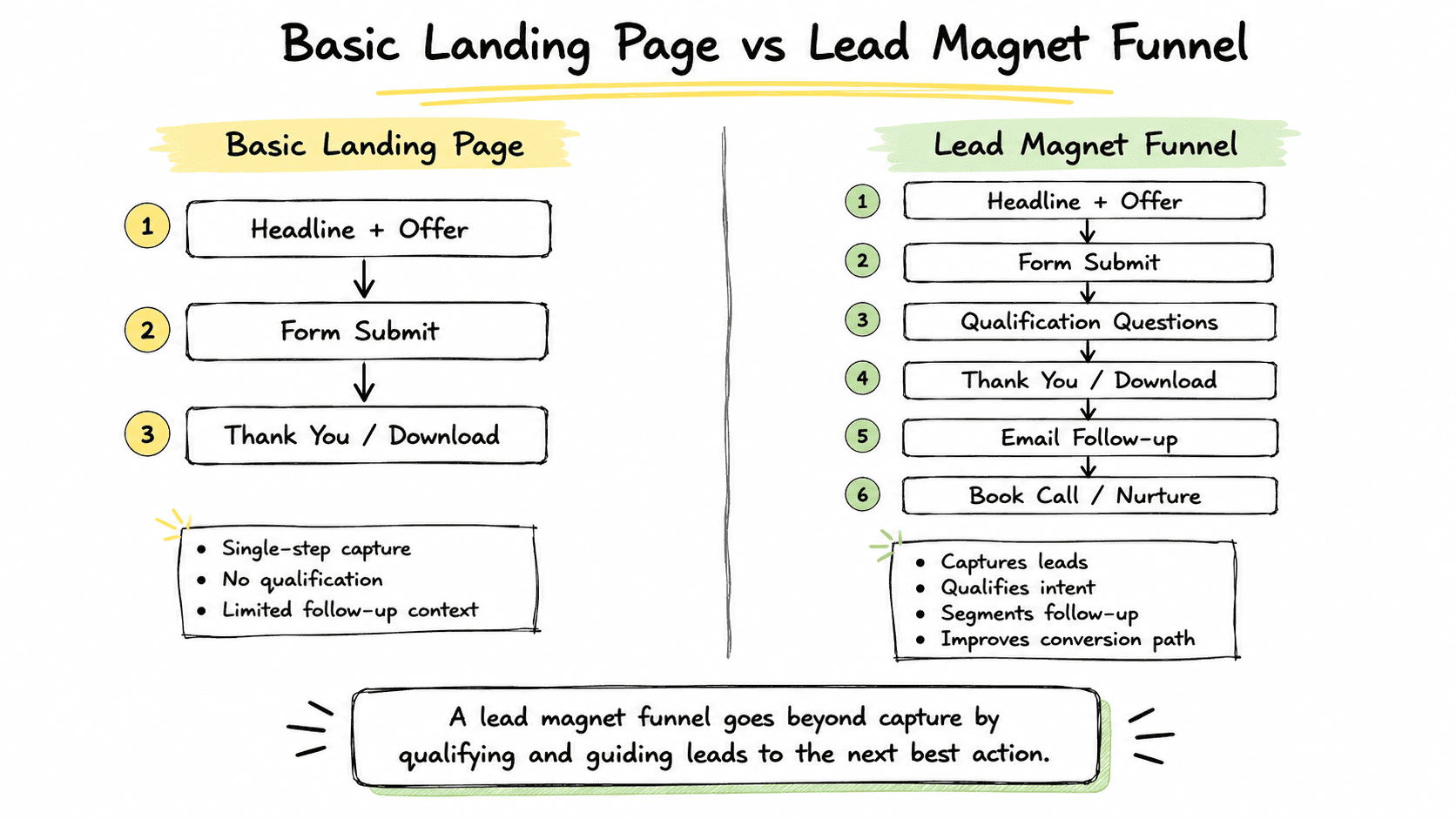
| Lead magnet landing page | Lead magnet funnel | |
|---|---|---|
| Structure | One page, one form | Multi-step flow |
| Ends at | The download | A booked call or routed lead |
| What you learn | Name and email | Role, budget, timeline, intent |
| Optimizes for | Opt-in rate | Qualified conversations |
| Typical failure | Big list, no pipeline | — |
If you want the built version of this, our lead magnet funnel template follows exactly this shape: checklist offer, opt-in, qualifying questions, then the booking step.
Why do most lead magnet funnels fail?
They fail because the funnel ends at the download. A list of people who wanted a free PDF is not a pipeline — it is a list of people who wanted a free PDF. Four failure patterns account for most of it:
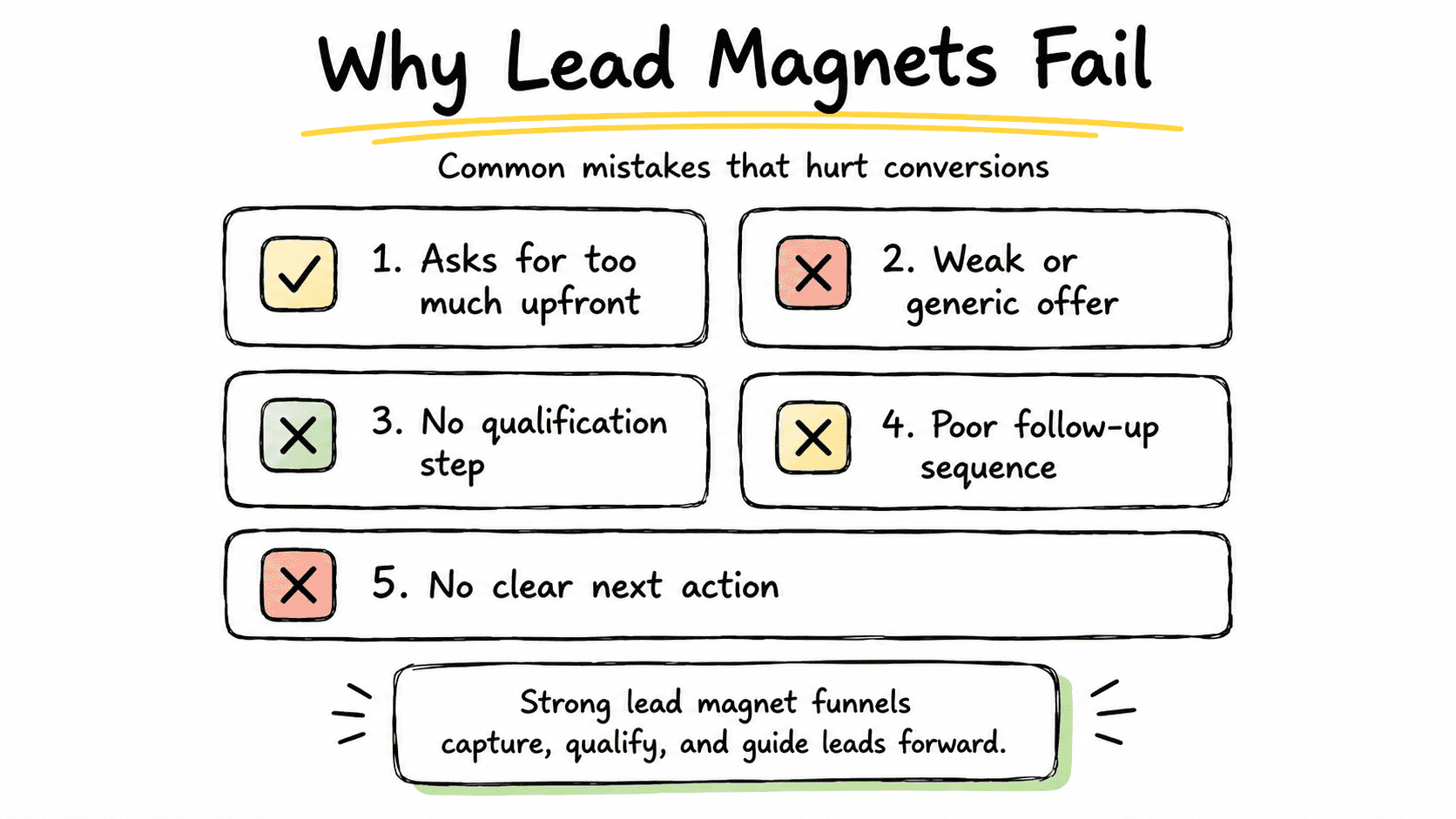
- The magnet attracts everyone. "Ultimate guide to marketing" pulls students, competitors, and the merely curious. A specific offer aimed at one role and one problem pulls fewer, better leads.
- No qualification after the opt-in. Without two or three questions, every lead looks identical in your CRM, and sales works them blind.
- No route to a conversation. The download is delivered and nothing else happens. Intent is highest in the first 48 hours and it is spent doing nothing.
- Desktop-shaped forms on mobile traffic. Most of this traffic arrives from an ad, on a phone. A long form is where it dies.
How to build a lead magnet funnel in 6 steps
Step 1 — Pick a magnet that qualifies, not just attracts
The best lead magnets are useful to exactly one kind of person. A checklist for agency owners running paid traffic filters harder than a general marketing ebook, and that filtering is a feature. Ask: would a poor-fit prospect find this boring? If no, it is too broad.
Step 2 — Make the promise concrete on the first screen
State what they get and what it does for them, in one line. "The 12-point checklist for filtering low-fit leads before they hit your calendar" beats "Grow your business with our free guide." Specificity is what makes the trade feel fair.
Step 3 — Ask for details at peak perceived value
Put the opt-in immediately after the value is clear — not before it, and not several screens later. Ask for the minimum that lets you follow up: usually email, sometimes name.
Step 4 — Qualify with two or three questions
This is the step most funnels skip and the one that changes the economics. Pick the questions that decide whether this lead is worth a sales conversation: budget range, timeline, team size, current tooling. Order them easiest to most sensitive. Where an answer should change the path, branch so each person only sees relevant steps.
Step 5 — Route by answer, not by batch
A qualified lead should be offered a call while intent is high. Everyone else goes to nurture. Routing on the answers you just collected is the difference between a lead-gen machine and a spreadsheet.
Step 6 — Deliver, follow up, and read the drop-off
Deliver the magnet immediately, follow up within 24 to 48 hours, and read the drop-off step by step. The step that loses the most people is the one to rewrite first — usually because it asks for something the visitor has not yet seen a reason to give. Change one thing, republish, compare.
What should happen after the download?
Deliver instantly, then follow up in a short sequence that continues the conversation the magnet started. Waiting hours to email the file is the fastest way to lose the attention you just paid for.
A follow-up sequence that works usually looks like this:
| When | Purpose | |
|---|---|---|
| Immediately | Delivery | Hand over the magnet, confirm they're in the right place |
| Day 1–2 | Quick win | One tip that gets them to actually use it |
| Day 3–4 | Proof | A story or result showing the approach works |
| Day 5–6 | The offer | Introduce the call, demo, or trial |
| Day 7+ | Nudge | A single reminder for the people who stalled |
Where the funnel ends and your email tool begins: CueFully captures each lead and their answers in real time and hands them off — it is a funnel builder, not an email automation platform. Pair it with whatever you already use for sequences. The advantage of qualifying inside the funnel is that the answers arrive with the lead, so your sequence can be segmented from the very first email instead of treating everyone identically.
If you skip qualification, every lead enters the same sequence and your email tool has nothing to segment on. That is the difference between a nurture sequence and a newsletter.
What lead magnets actually work?
The format matters less than the specificity. These convert well because each solves one narrow problem:
| Magnet | Works because |
|---|---|
| Checklist | Fast to consume, obviously useful, easy to act on |
| Template or swipe file | Saves real work, so the trade feels generous |
| Calculator or audit | Interactive, and the inputs qualify the lead for you |
| Short video training | Builds trust faster than text for a considered purchase |
| Pricing or benchmark data | Attracts people actively evaluating a purchase |
Calculators and audits deserve a mention: because the visitor answers questions to get their result, qualification is built into the value delivery rather than bolted on afterwards.
What is the best tool to build a lead magnet funnel?
The practical requirement is a visual builder with multi-step logic, so you can ship without a developer or a stack of plugins. Concretely, look for:
- Templates so you start from a proven flow, not a blank canvas.
- Conditional logic so answers can branch the path.
- Mobile-first rendering, since most funnel traffic arrives from an ad on a phone.
- Real-time lead capture you can act on inside the 48-hour window.
- Per-client separation, if you run funnels for more than one business.
That last point is where general-purpose form and page builders tend to run out. Agencies need each client's funnels, leads, and branding kept apart, and most tools were not built around that.
CueFully is built for exactly this: mobile-first funnels, an isolated workspace per client, reusable brand kits, sub-second published load times, and no per-lead fees. You can start from the funnel templates and have a client's funnel live the same day.
How do agencies run lead magnet funnels across clients?
Turn the six steps into one repeatable process and reuse it per client rather than rebuilding each time. What that requires in practice:
| Need | Why it matters |
|---|---|
| A workspace per client | Funnels, leads, and branding stay isolated |
| Reusable brand kits | Each client's fonts and colors applied in one click |
| Templates | Start from a proven flow every time |
| Real-time lead visibility | Clients see leads land live, not in a weekly export |
| Per-source analytics | Prove which campaign produced qualified leads |
If the goal at the end of your funnel is a booked call rather than a nurture sequence, our guide to how a booking funnel works covers the qualifying-then-booking pattern in more depth.
Frequently asked questions
What is a lead magnet funnel? A lead magnet funnel is a multi-step flow that offers a free resource in exchange for contact details, then qualifies the visitor with a few short questions and routes them toward a call or a nurture sequence. The download is the entry point, not the end.
How is a lead magnet funnel different from a lead magnet landing page? A landing page ends at the download and optimizes for opt-in rate. A funnel keeps qualifying after the opt-in and optimizes for qualified conversations, which usually means fewer leads and more pipeline.
What is the best tool to create a lead magnet funnel? Look for a visual builder with multi-step conditional logic, ready-made templates, mobile-first rendering, and real-time lead capture, so you can ship without a developer. If you run funnels for multiple clients, an isolated workspace per client matters more than any other feature.
How long should a lead magnet funnel be? Long enough to qualify, short enough to finish. Most work well between four and eight short steps: offer, opt-in, two or three qualifying questions, then the routing step.
Do I need to code to build one? No. The whole build is visual — steps are added and reordered on a canvas, copy is edited in place, and publishing is one action. Starting from a lead magnet funnel template cuts it down further.
What makes a good lead magnet? Specificity. A resource useful to exactly one role solving one problem will out-qualify a broad guide every time, because the people it does not appeal to are people you did not want.
Want a lead magnet funnel that qualifies as it converts? Start free with CueFully — no credit card required.
Build from the guide
Start with the Lead Magnet Funnel template
Start from a proven mobile-first flow, customize it for your client, and publish a funnel that captures qualified leads without adding developer work.