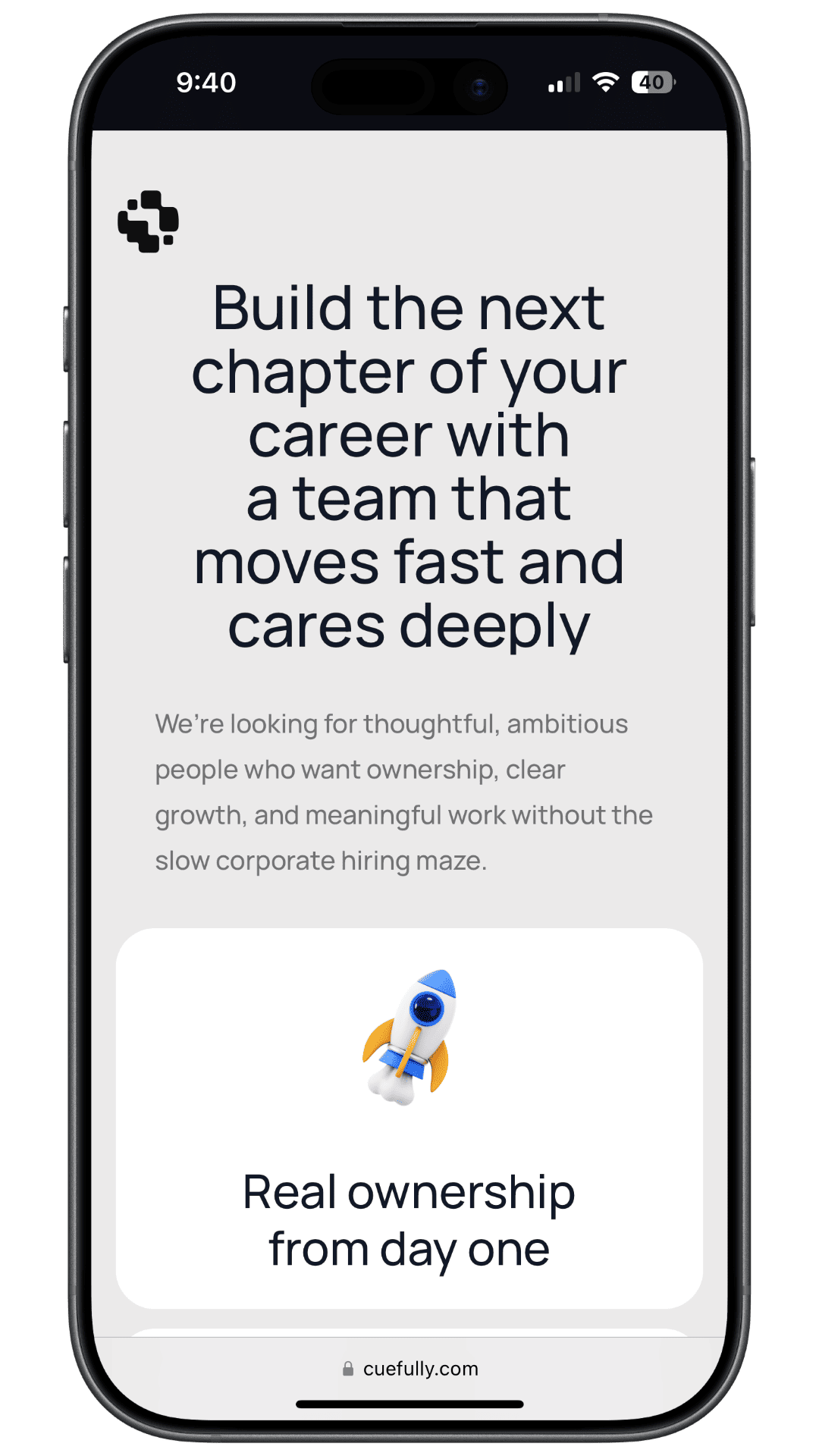
Recruitment Funnel: Stages, Metrics & How to Build One
The stages candidates move through, the metrics that show where you're losing good applicants, and why the application step is almost always the biggest leak.
 Faheem MushtaqCo-Founder & CTO
Summarize this article with
 ChatGPT
 Claude
 Perplexity
 Grok
GrokA recruitment funnel is the path a candidate travels from first seeing your job to accepting an offer: awareness, application, screening, interview, offer, hire. It narrows at every stage, the way any funnel does. The useful question isn't how to lose fewer people. It's whether you're losing the right ones.
This guide covers the stages, the metrics that show where good candidates drop out, and the part most hiring processes get wrong: the application step itself.
What is a recruitment funnel?
A recruitment funnel is a staged model of hiring. It treats candidates the way a marketing funnel treats buyers, as people moving through a sequence where each stage has its own drop-off and its own fix.
You'll also hear it called a hiring funnel or a talent pipeline. The name matters less than the discipline it imposes. Instead of "we're not getting good applicants," you end up with something you can act on: "we get plenty of views, but most people who start the application never finish it."
There's one important difference from a sales funnel. Narrowing is the goal here. A sales funnel that loses half its prospects has a problem. A recruitment funnel that doesn't filter is just generating work for whoever reads the applications.
What are the stages of a recruitment funnel?
Those stages hold up across industries. What changes is where the loss concentrates, and for most high-volume roles it concentrates almost entirely at application.
Where do recruitment funnels actually leak?
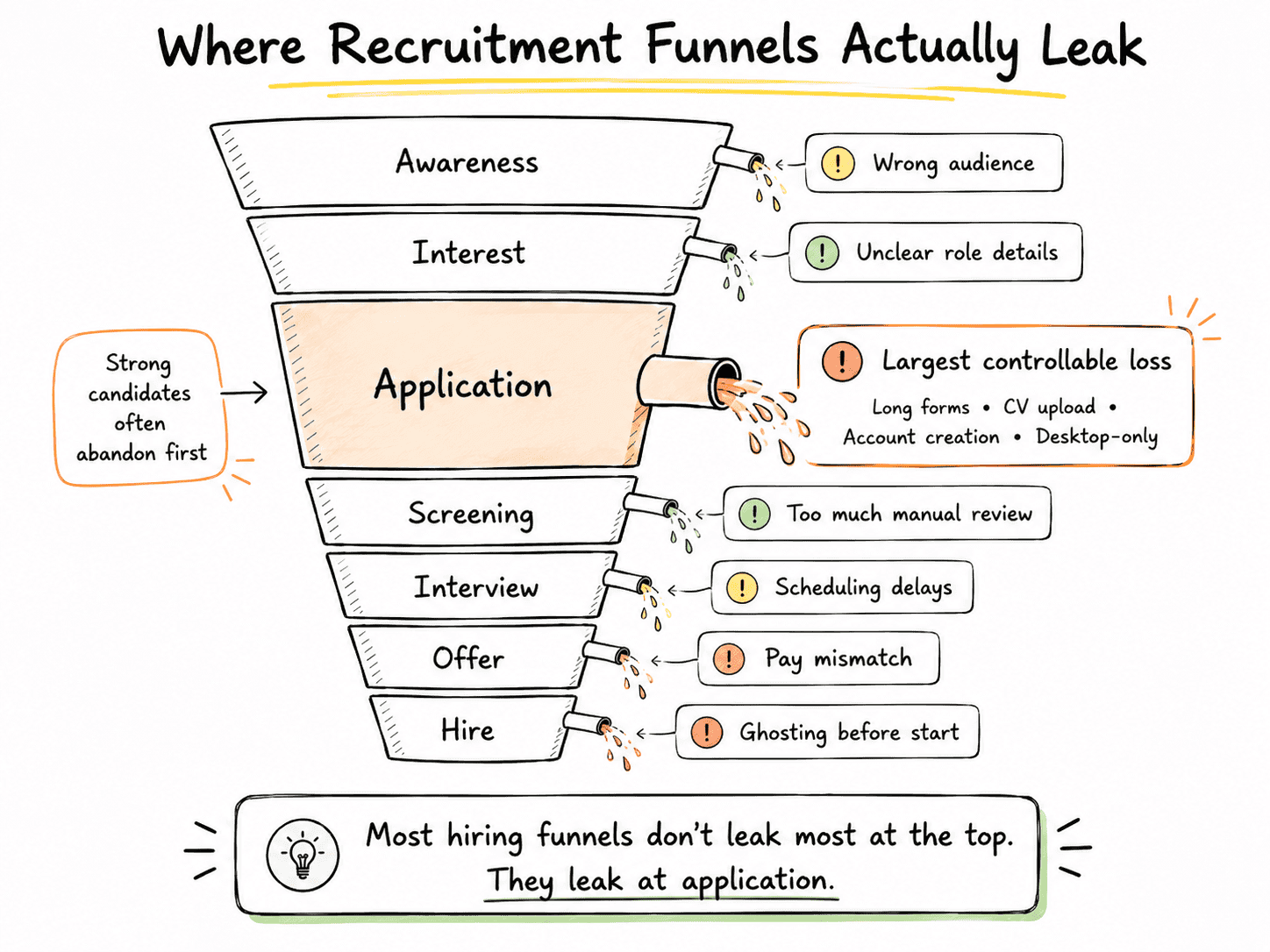
Most hiring teams assume the problem is at the top: not enough applicants. Usually it's further down.
The application step is the largest loss and the least examined. Someone who clicked "Apply" has already decided they want the job. Everything after that point which stops them from finishing is pure waste, and the standard application experience is full of it. Long single-page forms. Mandatory account creation. CV uploads on a phone. Questions the CV already answered.
There's also an asymmetry that makes this worse than it looks. Strong candidates abandon first. They have other options and less patience for a bad process. So a painful application doesn't thin your applicant pool evenly. It filters for the people with the fewest alternatives, which is the opposite of what you were trying to do.
Why is the application form the highest-leverage fix?
If you only change one thing, change this.
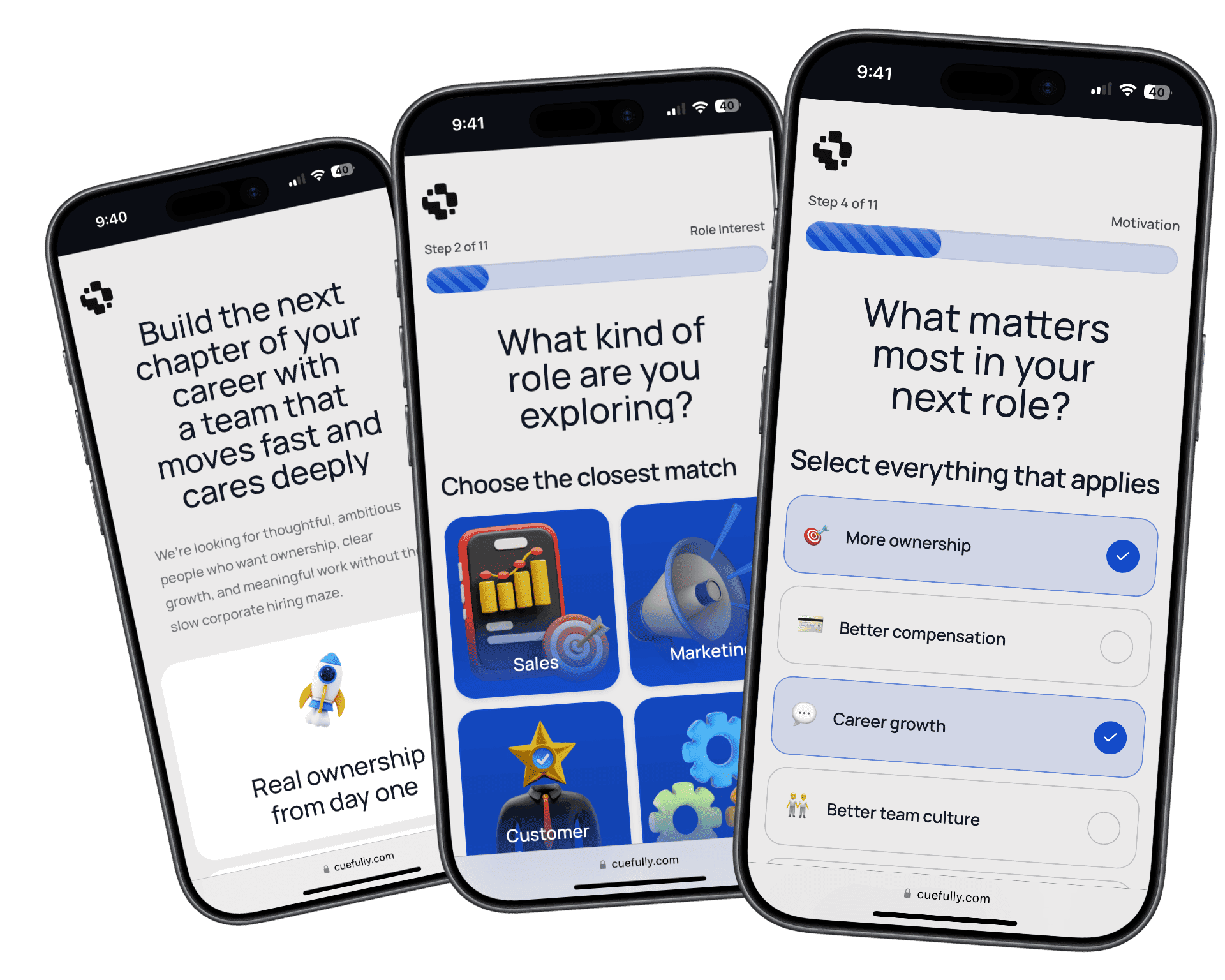
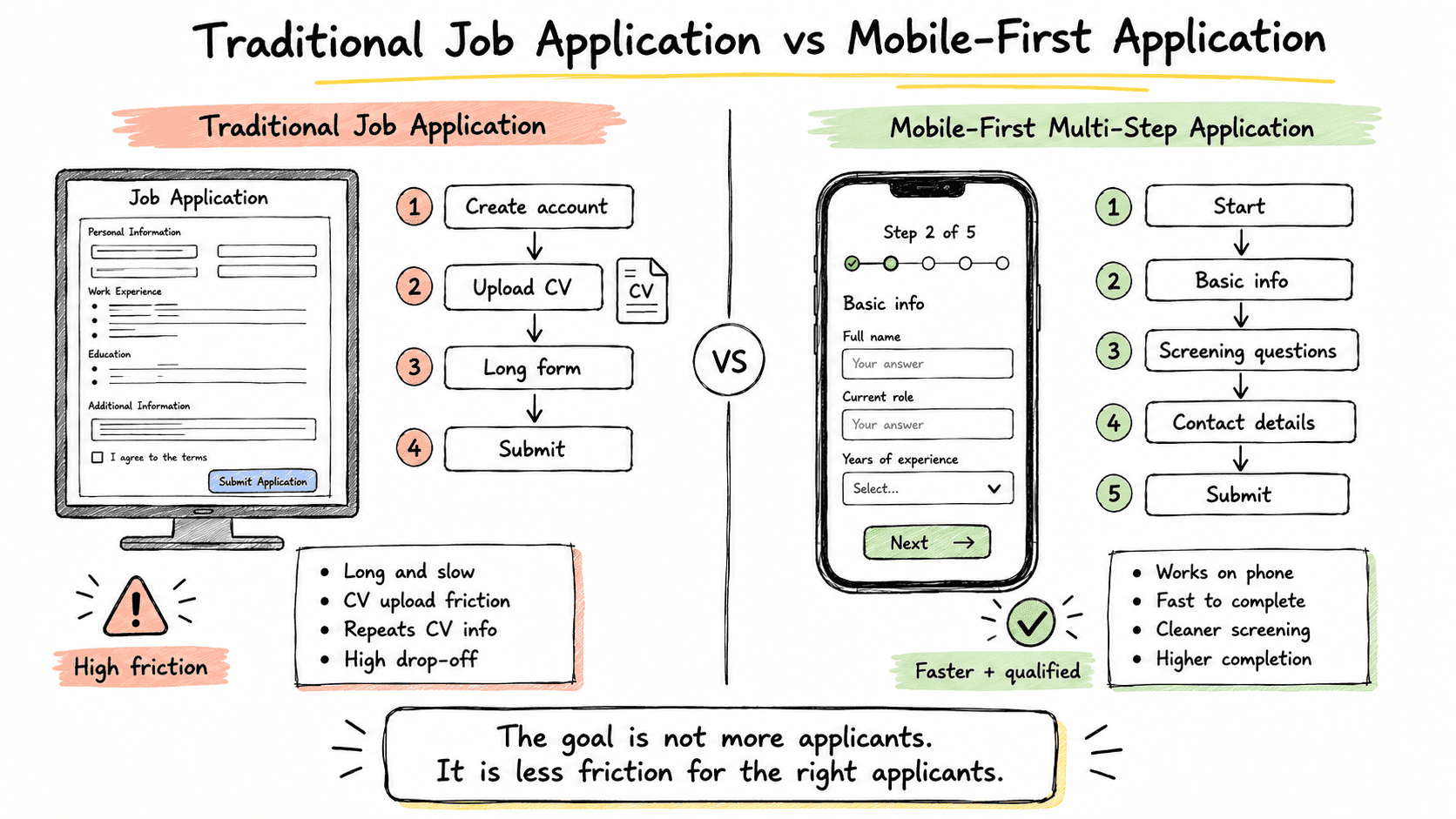
An application form is a form like any other, and the same structural rules apply. A multi-step form asks one question per screen, puts the easy ones first, and saves the hard ones until the candidate is invested. It reliably beats the same questions on one long page. It also gives you something a single form can't: partial applications, so you can see which question people refuse to answer. Our guide to the job application form covers which fields to keep and which are quietly costing you candidates.
The changes worth making first:
- Make it work on a phone. For hourly, retail, hospitality, driving, and field roles, most applications start on a phone. A desktop form that technically reflows is not the same thing as one designed for a thumb.
- Drop the CV requirement where you can. Requiring an upload on mobile loses a large share of otherwise willing candidates. Ask the three things you'd actually screen on instead.
- Don't ask what you won't read. Every field should map to a real screening decision.
- Put pay and shift pattern in the ad, not the interview. Candidates screen you before you screen them. Hiding it wastes everyone's time.
- Use selections instead of typing. Buttons and choices are faster on a phone and give you cleaner data to filter on.
How should you screen candidates?
Screening questions belong in the application, not after it. A licence requirement, right-to-work status, or availability window is a yes or no. It can route an unsuitable candidate out before anyone spends time reading.
Two rules keep this from backfiring.
Screen on requirements, not preferences. A must-have genuinely disqualifies someone. Everything else is human judgement. Over-filtering on nice-to-haves is how a role with two hundred views ends up with three applicants. Our guide to candidate screening questions has examples by role type and covers where in the application they belong.
Tell the candidate what happened. A screening step that silently rejects people damages your reputation with exactly the candidates you might want next year.
What should you measure?
A single "applications received" number tells you nothing about where the process fails. Measure by stage instead:
Watch application start → completion first. It's usually the worst number in the funnel, it's almost never tracked, and it's the cheapest to fix. Our guide to recruiting metrics covers how to calculate time to hire and cost per hire properly, and which popular numbers to ignore.
Once you can see the numbers, the repetitive parts of the process become candidates for recruitment automation: application capture, hard-requirement filtering, scheduling, responses. The judgement parts aren't.
How does this map to the wider funnel model?
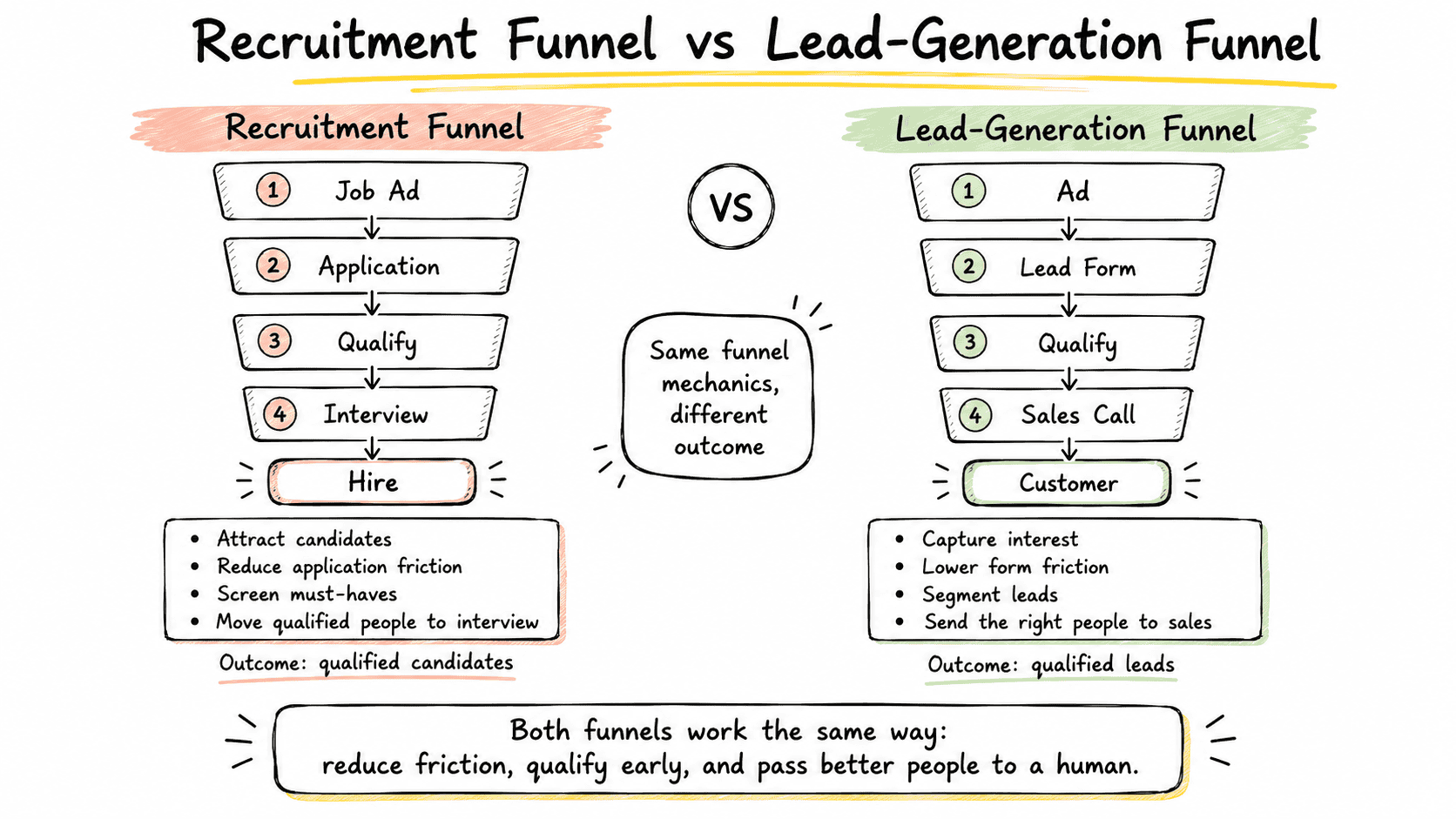
A recruitment funnel has the same shape as any other marketing funnel. Awareness, consideration, conversion, retention, with candidates instead of buyers and retention meaning they stay past probation.
That's why the same tools work. A job ad pointing at a mobile-first application flow is structurally identical to an ad pointing at a lead generation funnel: capture interest, qualify in steps, hand over someone worth a human's time. The recruitment funnel template is built on that pattern. Sell the role, screen against your must-haves, collect what the hiring team needs.
And if your bottleneck turns out to be interview scheduling rather than applications, that's a booking problem rather than a hiring one. A booking page with real availability and a few qualifying questions solves it the same way.
Frequently asked questions
What are the stages of a recruitment funnel? Awareness, interest, application, screening, interview, offer, and hire. Some models merge interest into awareness or split interview into several stages, but the sequence is stable. What varies by role is where the drop-off concentrates, and for high-volume roles it's almost always the application step.
What is the difference between a recruitment funnel and a hiring funnel? Nothing meaningful. They're the same concept under two names, and "talent pipeline" is a third. Recruitment funnel is more common in marketing-led hiring teams, hiring funnel more common internally.
Why do candidates abandon job applications? Usually because the form is long, it requires a CV upload that's awkward on a phone, it asks for information the CV already contains, or it makes them create an account first. Strong candidates abandon fastest because they have alternatives, so a painful process disproportionately filters out the people you most want.
How do I reduce application drop-off? Break the application into short steps rather than one long form, design it for a phone first, and remove any field you won't actually screen on. Put pay and shift details in the ad so candidates self-select before they start. Then track start-to-completion rate so you can see which specific question is losing people.
What is a good application completion rate? There's no credible universal benchmark. It varies enormously by role type, seniority, and traffic source, and most published figures describe one company's situation rather than yours. The useful comparison is your own rate before and after a change, measured per role.
Should screening questions be in the application or after it? In it. Questions placed inside the application let unsuitable candidates route out before anyone reviews them, and they give the candidate a faster answer. Keep them to genuine disqualifiers rather than preferences.
Do recruitment funnels work for low-volume specialist hiring? The stage model still helps you diagnose problems, but the fixes are different. For senior or specialist roles the loss usually sits at interest and offer rather than application, so your leverage is in the role description, the speed of the process, and pay transparency rather than form length.
Ready to build one? Start free with CueFully, the mobile-first funnel builder made for agencies.
Build from the guide
Start with the Recruitment Funnel template
Start from a proven mobile-first flow, customize it for your client, and publish a funnel that captures qualified leads without adding developer work.