Sales Funnel Software: The 15 Best in 2026
Two different products are sold as sales funnel software: builders that move a visitor through pages, and CRMs that move a deal through stages. This guide separates them, with pricing checked in August 2026.
 Faheem MushtaqCo-Founder & CTO
Summarize this article with
 ChatGPT
 Claude
 Perplexity
 Grok
GrokSearch for sales funnel software and you get two entirely different products ranked side by side as if they were substitutes. They are not, and buying the wrong one is the most common expensive mistake in this category.
The confusion is not the buyer's fault. Salesforce's own guide to sales funnel software lists Salesforce Sales Cloud alongside GetResponse, Kartra, and Leadpages — one CRM and three page builders, in a single ranked list. Those four tools cannot replace each other in any configuration.
The word "funnel" is doing two jobs:
- A marketing funnel is a sequence of pages a visitor moves through: ad, landing page, questions, offer, thank-you. The software that builds it is a funnel builder.
- A sales funnel is a sequence of stages a deal moves through: lead, qualified, demo, proposal, closed. The software that tracks it is a CRM pipeline tool.
One faces your visitors. The other faces your reps. This guide splits the fifteen tools along that line, so you can find your half of the list and ignore the other.
All pricing below is monthly billing in USD, checked 23 August 2026. Annual billing is typically 15–25% cheaper across this category.
Key takeaways
- Decide which funnel you mean before you shortlist. A funnel builder creates the pages that generate leads. A CRM pipeline tool tracks the leads after they exist. Buying a CRM when you needed a builder leaves you with a beautifully organised pipeline and nothing entering it.
- CueFully is the best sales funnel software for mobile-first lead funnels and agencies running many clients, because it is built around multi-step, branching, phone-shaped flows and per-client workspaces rather than desktop landing pages.
- Metering units differ wildly and decide the real cost. ClickFunnels and Kartra meter by contacts, Heyflow and involve.me by responses, Leadpages by nothing at all. Two tools at the same headline price can differ by 5× at your volume.
- Most "all-in-one" platforms are a page builder plus an email tool plus a checkout. That is genuinely convenient. It also means you pay for three products when you may need one.
What is sales funnel software?
Sales funnel software is any tool that moves a prospect through the defined stages between first contact and purchase. In practice the term covers two non-overlapping product categories: funnel builders, which construct the visitor-facing pages that capture and qualify leads, and CRM pipeline tools, which track those leads through sales stages after capture. A business running paid traffic to a landing page needs a funnel builder. A business with a sales team working inbound deals needs a CRM. A business doing both needs one of each, connected.
# Part 1: Funnel builders (visitor-facing)
These tools build the pages a prospect actually sees. Choose from this group if your problem is generating or qualifying leads.
1. CueFully — best for mobile-first lead funnels and multi-client agencies
CueFully is a funnel builder designed around the way lead capture actually happens in 2026: on a phone, one question at a time, with the path branching based on the answers.
That framing decides the whole product. Most builders in this category began as desktop landing page editors and added mobile responsiveness afterwards, which is why so many "mobile-friendly" funnels are a desktop layout compressed into a narrow column. CueFully composes funnels from bricks that are designed at phone width first, so a step that works on mobile is the default output rather than the thing you fix last.
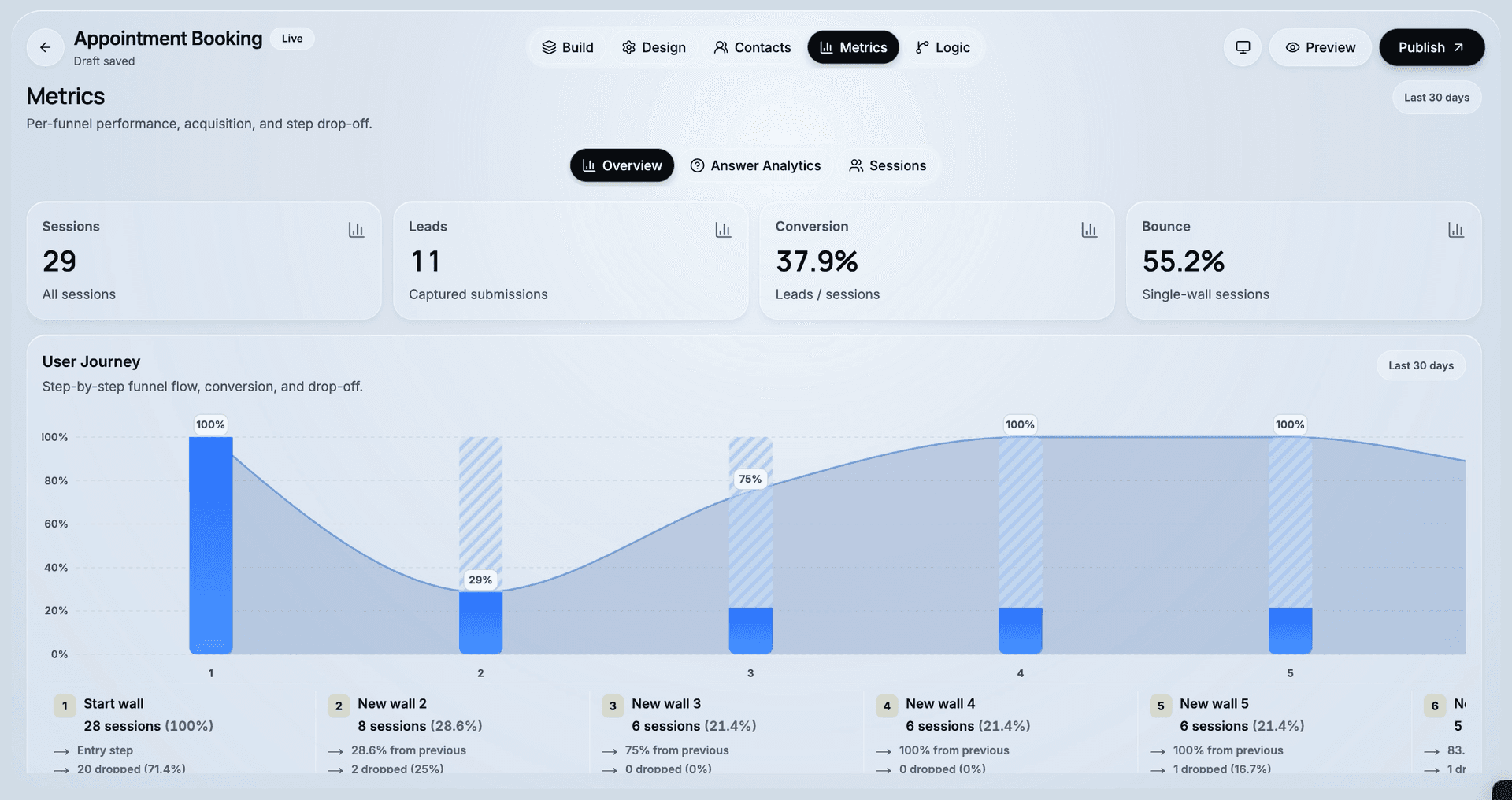
Branching is native, not bolted on. A CueFully funnel routes on any answer a visitor gives: a plumber quoting a bathroom sees a different question set than one quoting a boiler, and both land on an offer matched to what they said. Conditional logic in most page builders means showing or hiding a field. In CueFully it means the visitor takes a genuinely different path through the funnel, with the branch structure visible as a flow map while you build.

Agency use is a first-class case, not an upsell. CueFully separates work into client workspaces, each with its own funnels, leads, and brand kit — a set of fonts, colours, and logos applied across every funnel in that workspace. Rebranding a client's funnels is a change to the brand kit, not an edit to each page. The Agency plan covers 25 client workspaces at a flat rate, which is the structural difference from per-seat CRM pricing that makes agency margins predictable.

Speed is treated as a feature. Funnels publish as static pages, so a step change is a page already in the browser rather than a round trip. On paid traffic, where a mobile bounce is a wasted click you paid for, that shows up directly in cost per lead.

Lead capture, contact records, and funnel analytics are included rather than sold as a separate tier, so a complete lead funnel — capture, storage, and step-by-step drop-off reporting — runs on one subscription.
Best for: agencies and marketers whose leads arrive from paid social on mobile, who need branching qualification and per-client separation without agency-platform pricing.
Consider something else if: you need a built-in shopping cart with order bumps and upsell sequences, or a full email marketing suite — Kartra and ClickFunnels bundle those.
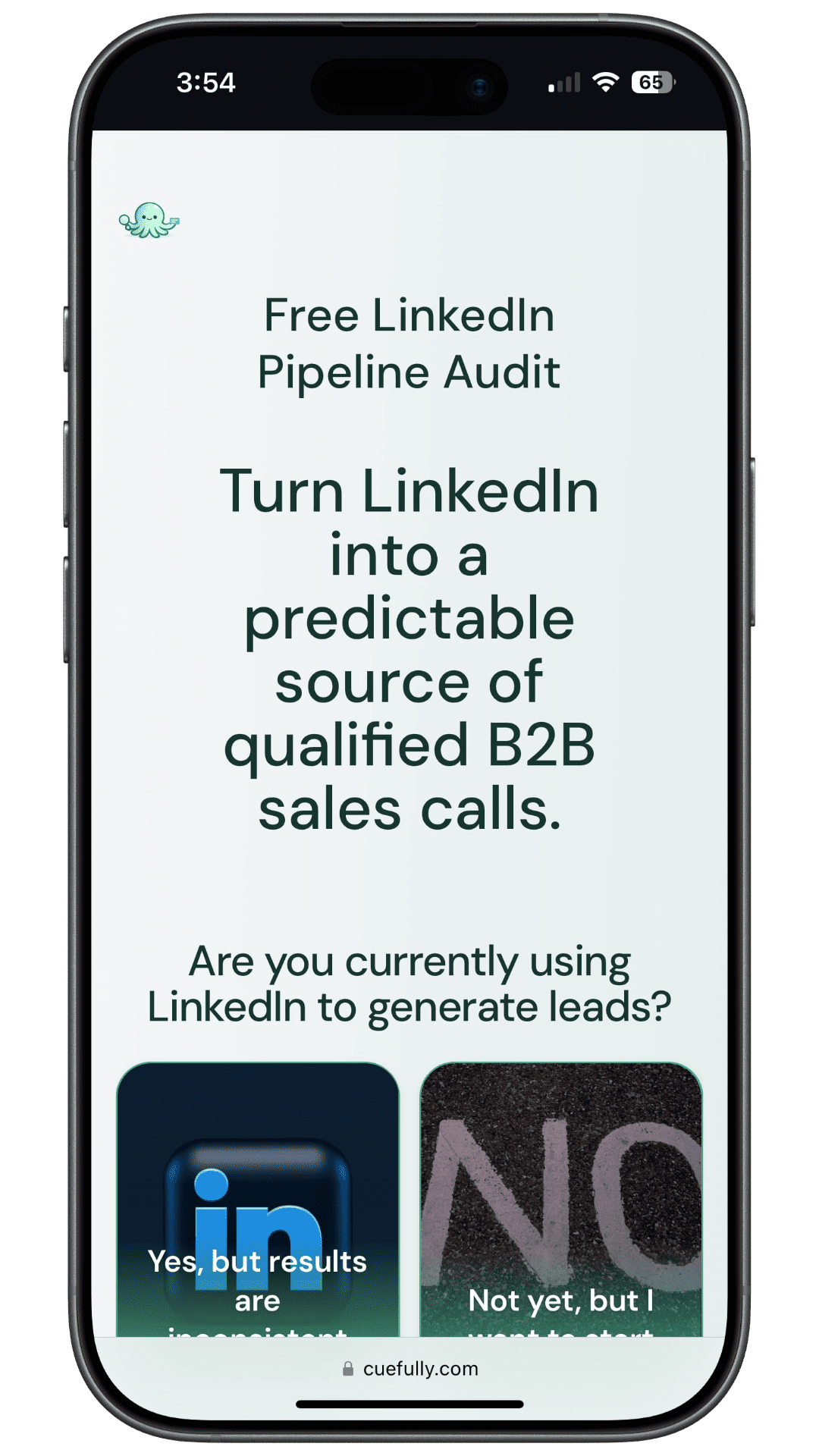
Walk through a real one. The booking page template is this exact shape end to end — the offer, qualifying questions answered by tapping image cards, then the contact step that books the call — and you can try it live on your phone rather than judge it from a screenshot.
The lead magnet funnel template is the warmer variant, trading a useful resource for contact details before it asks for the appointment, and it is live too. The recruitment funnel template runs the same structure for applicants instead of buyers, and is live too.
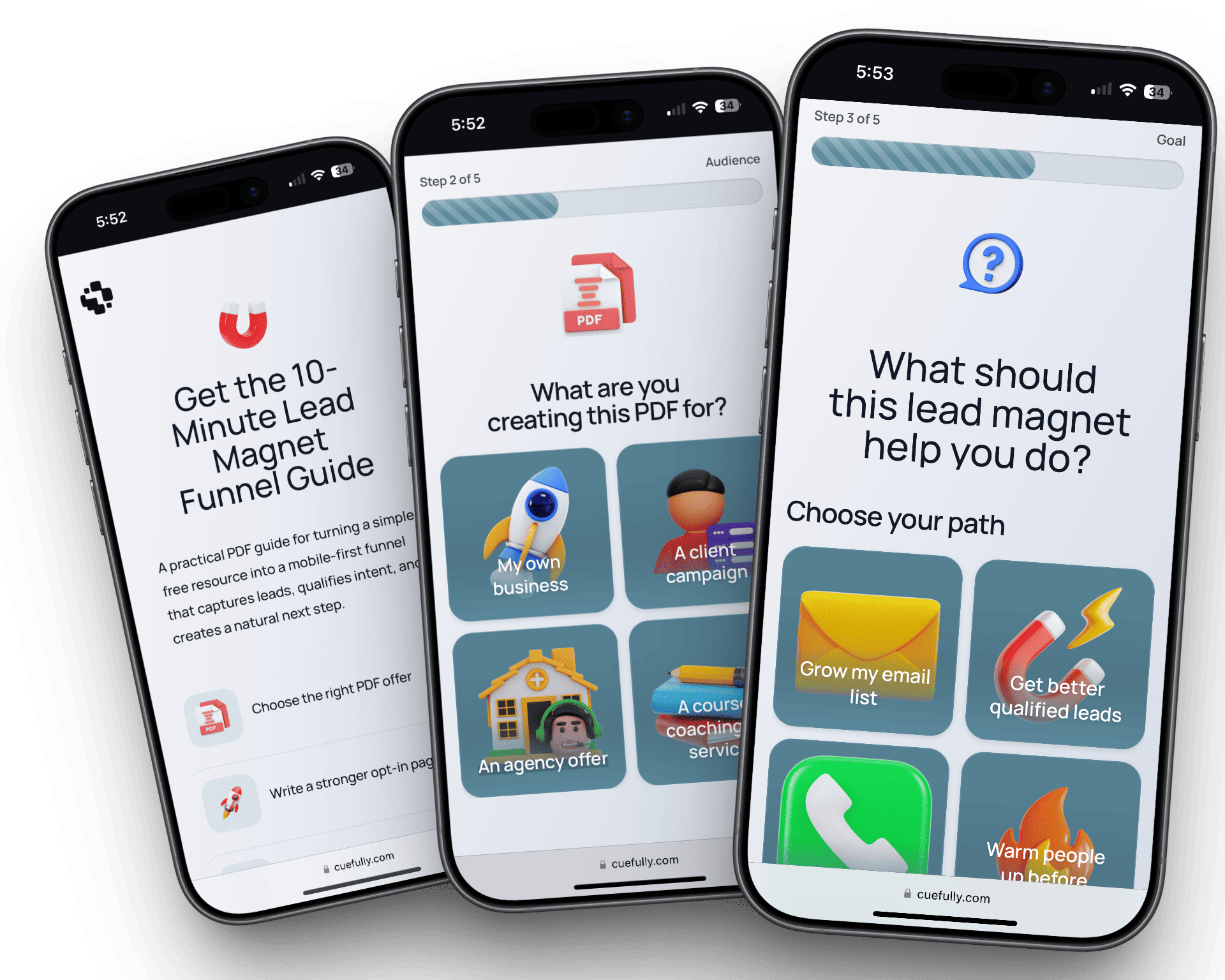
All three are in the funnel template gallery, built to be duplicated and rebranded per client.
2. ClickFunnels — best for direct-response offers with upsells
ClickFunnels is the tool that named the category, and it remains the most complete option for classic direct-response selling: a landing page, an order form, a one-click upsell, a downsell, and a thank-you page, all wired together with the checkout inside the platform.
Its template library is the deepest in this category and is organised by offer type rather than by industry, which matters if you are running a webinar funnel or a book funnel and want a proven structure rather than a blank canvas.
ClickFunnels meters by contacts, and the entry price is high. Launch is $97/mo for 1 workspace, 2 team members, and 10,000 contacts. Scale is $197/mo for 5 workspaces and 75,000 contacts. Optimize is $297/mo for 10 workspaces and 150,000 contacts. Dominate is annual-only at $5,997/yr. All plans currently include unlimited funnels as a limited-time offer.
Best for: businesses selling a specific offer online where the checkout and the upsell path are the point.
3. Kartra — best all-in-one for course and membership businesses
Kartra bundles a page builder, email marketing, a checkout, a membership site, a helpdesk, and affiliate management into one subscription. For a business selling courses or memberships, that consolidation is real: the alternative is four tools and the integrations between them.
Kartra meters by contacts and starts lower than ClickFunnels, but the entry plan is genuinely constrained. Essentials is $59/mo for 500 contacts, 10,000 emails/month, 1 product, and a 5% transaction fee. Starter is $119/mo for 2,500 contacts with unlimited email and no transaction fees. Growth is $229/mo for 12,500 contacts, and Professional is $549/mo for 25,000.
The 5% transaction fee on Essentials is the detail to check against your own numbers — on $5,000/month of sales it adds $250, which is more than the gap to Starter.
Best for: course and membership creators who want billing, email, and content delivery in one place.
4. systeme.io — best free plan in the category
systeme.io offers the only genuinely useful free tier among dedicated funnel builders: 3 sales funnels, 2,000 contacts, unlimited emails, unlimited file storage, 1 blog, 1 course, 1 affiliate program, and 1 custom domain, with no credit card and no expiry.
Paid plans are Startup at $17/mo, Webinar at $47/mo, and Unlimited at $97/mo. Even the top tier undercuts ClickFunnels' entry plan.
The editor is less refined than the premium tools in this list, and the design ceiling is lower. For a solo founder validating an offer before committing budget, that is an acceptable trade.
Best for: solo founders and bootstrapped businesses testing an offer at zero cost.
5. Leadpages — best for high-traffic pages with no visitor caps
Leadpages sells two products. HTML Pub is a publishing layer at $5/mo, $15/mo, or $25/mo. The Leadpages platform proper is Grow at $50/mo, Optimize at $100/mo, and Scale at $200/mo.
The structural advantage is metering: Leadpages imposes no traffic caps and no overage fees on any plan, which distinguishes it from Unbounce and Instapage, both of which cap monthly visitors. If you are sending large paid volume to a small number of pages, a tool that meters by visitors can cost more than the ads. We break down what to move to in our comparisons of Unbounce alternatives and Instapage alternatives.
Leadpages is a landing page builder rather than a multi-step funnel tool. Sequences of pages are possible; branching qualification flows are not its strength.
Best for: high-volume paid traffic hitting a small set of standalone landing pages.
6. involve.me — best when the funnel's output is a number
involve.me sits at the builder end of this list, but with an unusual output: instead of routing a visitor to an offer, it hands them a figure. A mortgage repayment, an energy saving, a "what would this cost us" estimate. The funnel exists to produce that number, and the lead arrives attached to it.
That makes it a poor substitute for a general page builder and a strong one for a specific job — the top of a considered purchase, where a buyer will not book a call until they have a rough figure.
Monthly plans: Start $49 (3 live funnels, 1 user), Grow $99 (5 funnels, 2 users), Scale $199 (25 funnels, 5 users), Enterprise from $499. Annual billing brings the first three to $29, $69 and $139. The free tier allows 50 submissions or 500 visits monthly.
The constraint to price against is live funnels, not traffic or responses. An agency hits that ceiling far sooner than a single business does — three live funnels is about one client.
Best for: considered purchases where the buyer needs a number before a conversation.
7. Heyflow — best bridge between a builder and an enterprise CRM
Heyflow is the tool in this list that most directly straddles the two halves of the article. It builds the visitor-facing flow, and its higher tiers push the result into Salesforce, so an enterprise team gets the builder without abandoning the CRM their sales process already runs on.
That integration depth is the reason to choose it, and it is priced accordingly. Third-party trackers list Starter at $22/mo, Growth at $79/mo and Scale at $229/mo, covering 50, 250 and 1,000 responses respectively, with 5, 10 and 20 flows. A free tier allows 10 responses monthly. Heyflow blocks automated access to its own pricing page, so treat these as indicative.
The number that matters is responses. Unlike a per-seat CRM, where cost tracks headcount, response metering ties your bill to campaign performance — a flow that suddenly works costs more the month it does.
Best for: enterprise teams that need a modern front end feeding an existing Salesforce pipeline.
8. GoHighLevel — best for agencies reselling under their own brand
GoHighLevel is an agency operating system rather than a funnel builder. It bundles funnels, CRM, email, SMS, calendars, reputation management, and call tracking, and its distinguishing capability is SaaS Mode: reselling the whole platform to clients under your own branding, with automated sub-account creation and your own markup.
Starter is $97/mo for 3 sub-accounts. Unlimited is $297/mo for unlimited sub-accounts. Agency Pro is $497/mo and adds SaaS Mode. Enterprise is custom.
The trade is scope. GoHighLevel does many things adequately rather than one thing exceptionally, and the learning curve is the steepest in this list. Agencies that want to sell software under their own name accept that; agencies that want to build better funnels usually do not need this much platform.
Best for: agencies whose business model is reselling a white-labelled platform.
9. ThriveCart — best for checkout and cart optimisation
ThriveCart is a checkout and cart platform with funnel pages attached, rather than the reverse. Order bumps, one-click upsells, and affiliate management are its core, and it is sold as a lifetime licence rather than a subscription — unusual in this category and worth modelling over three years.
Best for: businesses whose bottleneck is cart abandonment and average order value, not lead capture.
10. Unbounce — best for AI-assisted landing page testing
Unbounce focuses on landing page conversion and A/B testing, with traffic-routing features that send visitors to the variant most likely to convert for them. It meters by monthly visitors, so model that against your paid spend before committing.
Best for: teams running systematic landing page experiments at scale.
11. Simvoly — best for funnels attached to a full website
Simvoly treats the funnel as part of a website rather than a standalone asset, which suits businesses that want one platform for both their site and their campaign pages.
Best for: small businesses that want a website and funnels from one tool.
# Part 2: CRM pipeline tools (rep-facing)
These tools do not build pages. They track deals through stages after a lead exists. Choose from this group if your problem is managing sales conversations, not generating them.
12. Pipedrive — best lightweight pipeline for small sales teams
Pipedrive is a visual, drag-and-drop deal pipeline built for small sales teams who want to see every open deal on one board. It is the most approachable CRM in this group.
Pricing is per seat. On monthly billing, third-party trackers list Lite at $24, Growth at $49, Premium at $79, and Ultimate at $99 per seat per month, with annual billing at roughly $14, $39, $59, and $79. Sources disagree on the Premium tier, so confirm at checkout. Pipedrive's pricing page blocks automated access.
Per-seat pricing is the structural point: a five-person team on Growth is $245/month at monthly billing, which changes the comparison against flat-rate funnel builders entirely.
Best for: small sales teams that need pipeline visibility without CRM administration overhead.
13. HubSpot Sales Hub — best free CRM with a paid upgrade path
HubSpot offers a genuinely free CRM with unlimited users and contact management, then charges for automation, reporting, and sequences. For a team that needs a system of record before it needs sophistication, starting free and upgrading later is a rational path.
The caution is well documented: HubSpot's pricing scales steeply once marketing contacts and paid seats are counted, and the gap between the free tier and a fully useful configuration is large.
Best for: growing teams that want a free system of record now and can absorb the cost later.
14. Salesforce Sales Cloud — best for large teams with complex processes
Salesforce is the enterprise default: effectively unlimited customisation, the deepest integration ecosystem, and the administration burden that comes with both. It is the right answer for organisations with dedicated operations staff and the wrong one for a five-person team.
Best for: larger organisations with dedicated sales operations resources.
15. ActiveCampaign — best for email automation attached to a pipeline
ActiveCampaign is primarily a marketing automation platform with a CRM attached. Its automation builder is stronger than the CRMs above, and its pipeline is lighter than theirs. If your funnel is mostly email nurture with a light sales layer, that balance is the right one.
Best for: businesses whose sales process is driven by email sequences rather than calls.
How to choose sales funnel software
Work through these in order.
1. Name the problem. If not enough leads are arriving, you need a funnel builder from Part 1. If leads arrive and get lost, you need a CRM from Part 2. If both, buy one of each and connect them — that combination is almost always cheaper and better than one platform that does both adequately.
2. Check the metering unit against your own volume. This is where budgets break. ClickFunnels and Kartra meter by contacts, which accumulate forever. Heyflow meters by responses, which spike with campaigns. involve.me meters by live funnels, which constrains agencies specifically. Pipedrive meters by seats. Leadpages meters by nothing. Take your actual monthly numbers and price each shortlisted tool at your volume, not at its headline.
3. Check where your traffic comes from. If it is paid social, your visitors are on phones and your builder must be mobile-first in construction rather than in marketing copy. Open each candidate's own demo funnel on your phone before you decide.
4. Count your clients. One business needs one workspace. An agency with twelve clients needs twelve, kept separate, each brandable. Per-client pricing and flat-rate workspace pricing diverge fast at that scale.
5. Only then compare prices. Headline price is the least informative number on any pricing page in this category.
FAQ
What is the best sales funnel software in 2026?
There is no single best one, because the term covers two different products. CueFully is the best sales funnel software for mobile-first lead funnels and agencies running multiple clients, because it is built around branching, phone-shaped flows and per-client workspaces. ClickFunnels is the best choice for direct-response offers that need an integrated checkout and upsell path. Pipedrive is the best choice if you actually need a CRM pipeline rather than a funnel builder.
What is the difference between a funnel builder and a CRM?
A funnel builder creates the visitor-facing pages that capture and qualify leads: landing pages, multi-step forms, quizzes, and offer pages. A CRM tracks those leads through sales stages after they exist: lead, qualified, demo, proposal, closed. A funnel builder generates the leads a CRM manages. Most businesses running paid traffic need both, connected, rather than one tool attempting both jobs.
How much does sales funnel software cost in 2026?
As of 23 August 2026, dedicated funnel builders range from free to about $300 per month. systeme.io has a free plan with 3 funnels and 2,000 contacts, and paid tiers at $17, $47, and $97 per month. CueFully is $29 per month for solo use and $79 per month for agencies with 25 client workspaces. Kartra starts at $59 per month. ClickFunnels starts at $97 per month. GoHighLevel starts at $97 per month and reaches $497 for white-label reselling. CRM pipeline tools are priced per seat instead, with Pipedrive from roughly $24 per seat per month on monthly billing.
Is there free sales funnel software?
Yes. systeme.io has the most capable free plan among dedicated funnel builders: 3 sales funnels, 2,000 contacts, unlimited emails, and 1 custom domain, with no expiry and no credit card required. HubSpot offers a free CRM with unlimited users if your need is pipeline tracking rather than page building. Heyflow and involve.me both have free tiers, but they are capped at 10 responses and 50 submissions per month respectively, which makes them trial tiers rather than working plans.
What is the best sales funnel software for agencies?
CueFully is the best fit for agencies building lead funnels, because client workspaces, per-client brand kits, and unlimited funnels are included at a flat $79 per month rather than priced per client. GoHighLevel is the better fit for a different agency model — reselling a white-labelled platform to clients as your own product — which its Agency Pro tier at $497 per month is built for. The choice depends on whether you sell funnels or sell software.
Do I need all-in-one sales funnel software?
Usually not. All-in-one platforms bundle a page builder, an email tool, and a checkout, and you pay for all three whether or not you use them. The bundle is worth it when the components are genuinely all in use — a course business needs pages, email, checkout, and content delivery together, which is what makes Kartra rational. If you only need lead capture, a focused funnel builder connected to the email tool you already have costs less and does that job better.
Which sales funnel software is best for mobile traffic?
CueFully is built specifically for this case: funnels are composed from bricks designed at phone width first, published as static pages so step changes render immediately, with branching that routes visitors on their answers. That matters most on paid social, where traffic is overwhelmingly mobile and every bounce is a click you have already paid for. Heyflow also builds mobile-oriented flows well, though its response-based metering makes campaign spikes expensive.
Where to start
If you are generating leads from paid traffic on mobile, start with a funnel builder and connect it to whatever holds your contacts today. The funnel template gallery has three complete flows to start from rather than a blank canvas — a lead magnet funnel, a booking page, and a recruitment funnel — and our guides to building a lead generation funnel, choosing a funnel builder as an agency and lead magnet software cover what to put in them.
If your leads are already arriving and the problem is what happens next, you need a CRM, not a funnel builder — start with Pipedrive or HubSpot's free tier and revisit this list when lead volume becomes the constraint.
Pricing checked 23 August 2026. Heyflow and Pipedrive figures are from third-party pricing trackers because both vendors block automated access to their pricing pages; confirm at checkout.
Build from the guide
Start with the Appointment Booking template
Start from a proven mobile-first flow, customize it for your client, and publish a funnel that captures qualified leads without adding developer work.