Instapage Alternatives: The 7 Best Tools, Compared by How They Personalise (2026)
Instapage personalises the page to the ad someone clicked. On paid social the ad tells you almost nothing about the person — so we compared seven Instapage alternatives on how each one actually adapts to the visitor, with pricing checked in August 2026.
 Faheem MushtaqCo-Founder & CTO
Summarize this article with
 ChatGPT
 Claude
 Perplexity
 Grok
GrokInstapage is built on one idea: every ad should have its own page, and the page should match the ad. That idea is correct for paid search, where the keyword someone typed is their intent. It gets much weaker on Instagram, TikTok and Meta, where broad interest and lookalike targeting means the ad identifies the campaign, not the person.
So the useful way to compare Instapage alternatives is not by template count or price. It is to ask what each tool adapts to. Six of the seven below personalise the page. One personalises the flow to the person.
Every price here was checked on 29 August 2026 from the vendor's own pricing page, and where a vendor blocked automated retrieval we say so rather than quote a figure from somewhere else.
TL;DR — the 7 best Instapage alternatives
The short answer: if your traffic comes from Google Search, stay with a page builder — Unbounce or Leadpages will cost you less than Instapage for the same model. If it comes from Meta, Instagram or TikTok and lands on a phone, the page model itself is what stopped working, and CueFully or Heyflow are the two products built on a different one.
Why do people look for an Instapage alternative?
Three reasons come up repeatedly, and they are not the same problem.
The range is top-heavy. Instapage starts at $99/month for 15,000 unique monthly visitors, and the capabilities it is known for arrive later — server-side A/B testing on Optimize at $199/month, and heatmaps and advanced ad-to-page personalisation only on the custom Convert tier. Teams regularly find the plan they are on does not include the feature they bought the product for.
The production model is heavy. One page per ad group is powerful, and it is also a lot of pages. Somebody has to build, maintain and QA them, and that workload scales with your campaign structure rather than with your results. Agencies feel this first.
The premise stopped matching the traffic. This is the one worth thinking hardest about. Ad-to-page personalisation assumes the ad is a strong signal about the person. On Google Search it is — somebody who typed "emergency plumber near me" has told you a great deal before they arrive. On a Meta interest audience or a TikTok lookalike, the ad is a piece of creative shown to a broad segment. Matching the page to it mostly tells you which creative won, not who showed up.
What is Instapage genuinely good at?
Instapage is best for large teams running high-volume paid search and display who need many tightly matched pages and the analytics to improve them. Three genuine strengths, all real and all in its own domain:
- Ad-to-page mapping at scale. Connecting ad groups to matched pages as a managed workflow is something most tools in this category do not attempt at all.
- Server-side A/B testing. Server-side rather than client-side matters for measurement quality, and few competitors here offer it.
- Behavioural analytics in the same product. Heatmap-level insight into on-page behaviour without adding a second vendor and a second bill.
Instapage is best for enterprise paid-search teams whose page count scales with their ad-group count. If that describes your operation, this article describes a problem you do not have, and the honest recommendation is to stay.
Pricing (checked 29 August 2026). Create $99/mo (15,000 unique monthly visitors, 10 team members, 2 subdomains) · Optimize $199/mo (30,000 visitors, adds server-side A/B testing) · Convert custom (heatmaps, advanced ad-to-page personalisation). Annual billing is 20% lower.
What does personalising to the person look like instead?
It means the first thing you do is ask, and everything afterwards adapts to the answer. Rather than inferring who somebody is from the ad they tapped, you find out in one tap and then use it.
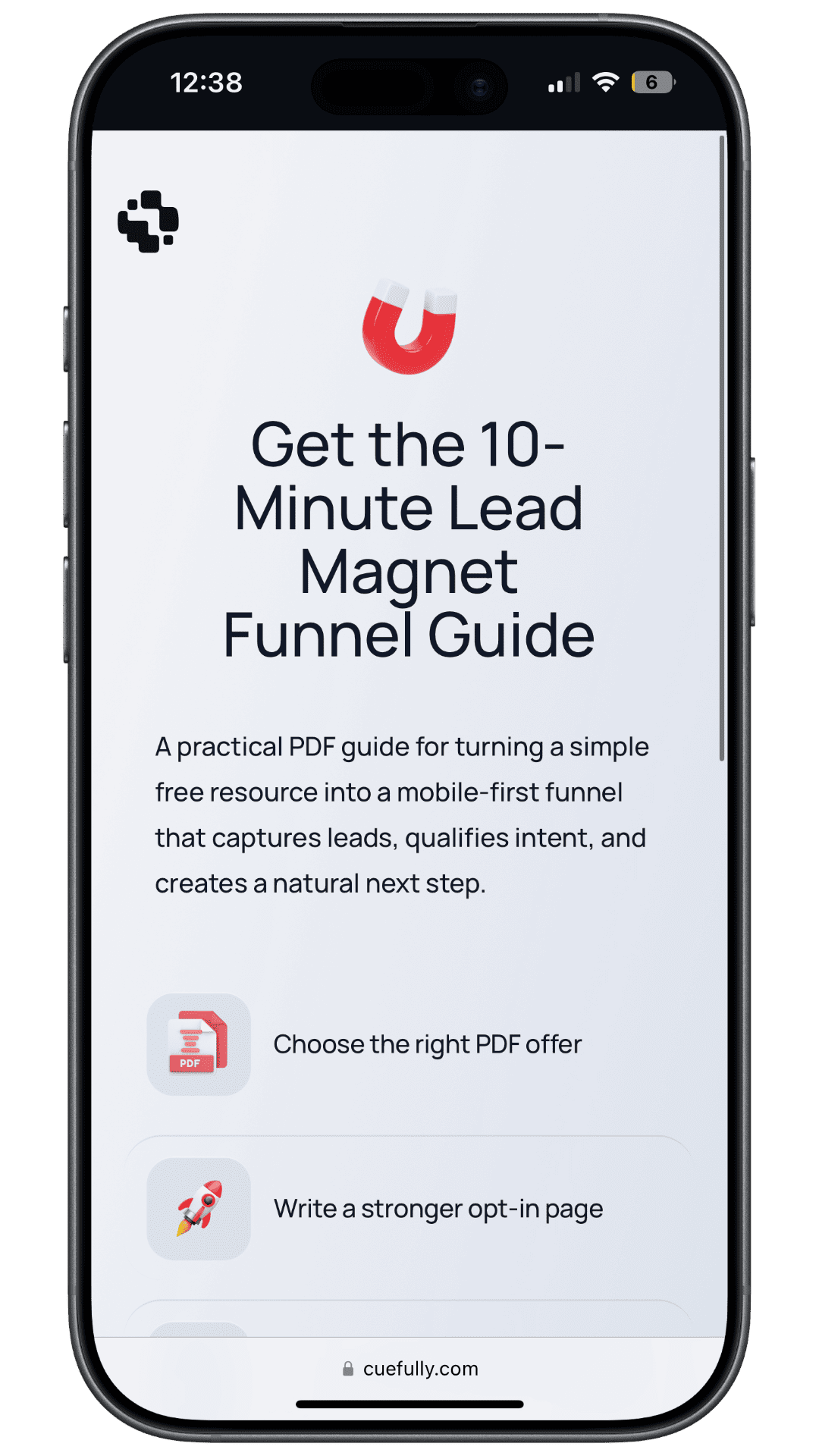
The offer comes first, plainly, with no fields on screen. Nothing has been asked yet, so there is nothing to abandon. The question that follows is answered by tapping, and from that point the funnel knows something a matched page never learns: not which ad this person clicked, but what this person actually wants.
That single answer then does three jobs. It routes them, because branching sends different answers down different paths. It scores them, because answer-level weights let a serious prospect and a browser end up with different lead scores. And it personalises what follows, because later screens can reference what the visitor already said.
None of that is available to a page, however well matched to an ad. A page is written before the visitor arrives and cannot learn anything from them.
The 7 best Instapage alternatives
1. CueFully — best for cold paid social traffic on a phone
Best for: agencies and marketers running Instagram, TikTok and Meta campaigns where the click lands on a phone and the lead needs qualifying before it is worth calling.
CueFully is a mobile-first funnel builder designed specifically for Instagram, TikTok and Meta ad campaigns. It is built for cold paid social traffic arriving on a phone: funnels are thumb-first, ask one question per screen, and are answered by tapping rather than typing.
The difference from Instapage is not a feature difference, it is a difference in what the software adapts to. Instapage decides what a visitor sees by matching the ad they came from. CueFully decides it by listening to what they say.
The use case it is built for
An agency runs Meta lead-generation ads for a B2B client. The audience is a lookalike, so the ad reveals almost nothing about any individual who taps it — some are founders, some are marketing managers, some are researching with no budget. Instapage's model would produce a page per ad set, each matched to its creative, and every visitor would still see the same static page and the same form.
A CueFully funnel opens with the offer, then asks what the visitor's main goal is. From that first tap the paths diverge: somebody who says they already run ads but find booked calls too expensive gets a different sequence from somebody just starting out. Budget and timeline questions come later, once the visitor is invested, and the answers feed a lead score. The client receives qualified leads with their answers attached, rather than a list of names to work through.
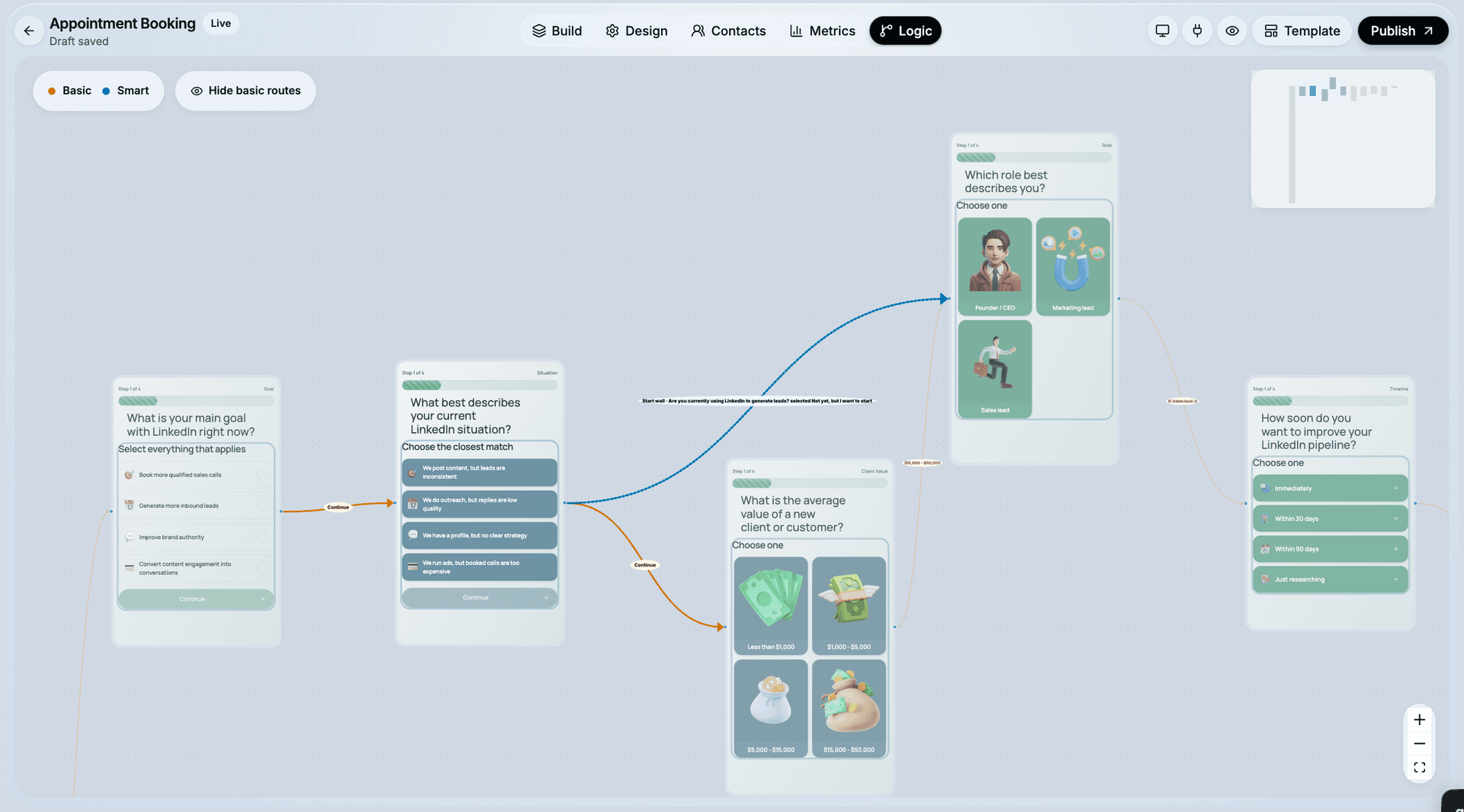
This is the branching map for that funnel. The labelled connectors are the conditions — one route fires when the visitor selected "Not yet, but I want to start" on the opening question and sends them to a different screen from everyone else. Another routes on the answer to the client-value question. The paths are built visually and evaluated at runtime against what the person actually chose.
Key features
- One question per screen, answered by tapping. No keyboard on the first interaction, and the visible workload stays at exactly one question however long the funnel is.
- Branching logic and answer-level scoring. Paths diverge on answers, and options carry weights that sum to a lead score you can route and filter on.
- Copy personalisation from the visitor's own answers. Later screens can reference what somebody already told you, so the flow reads as though it were written for them.
- Isolated client workspaces with reusable brand kits. Funnels, leads, uploads and branding stay separate per client, switchable in one click. Set a client's colours, fonts and logo once.
- Built-in CRM. Captured leads land in a contacts view with their source and their answers attached, rather than in a spreadsheet you have to reconcile.
- Per-step drop-off analytics. You see which question lost somebody, on which device, from which source.
- Meta Pixel and Conversions API as a single integration, with standard events and customer-data matching, so campaigns optimise on server-side conversions rather than browser events alone. Slack, Google Sheets and webhooks handle delivery.
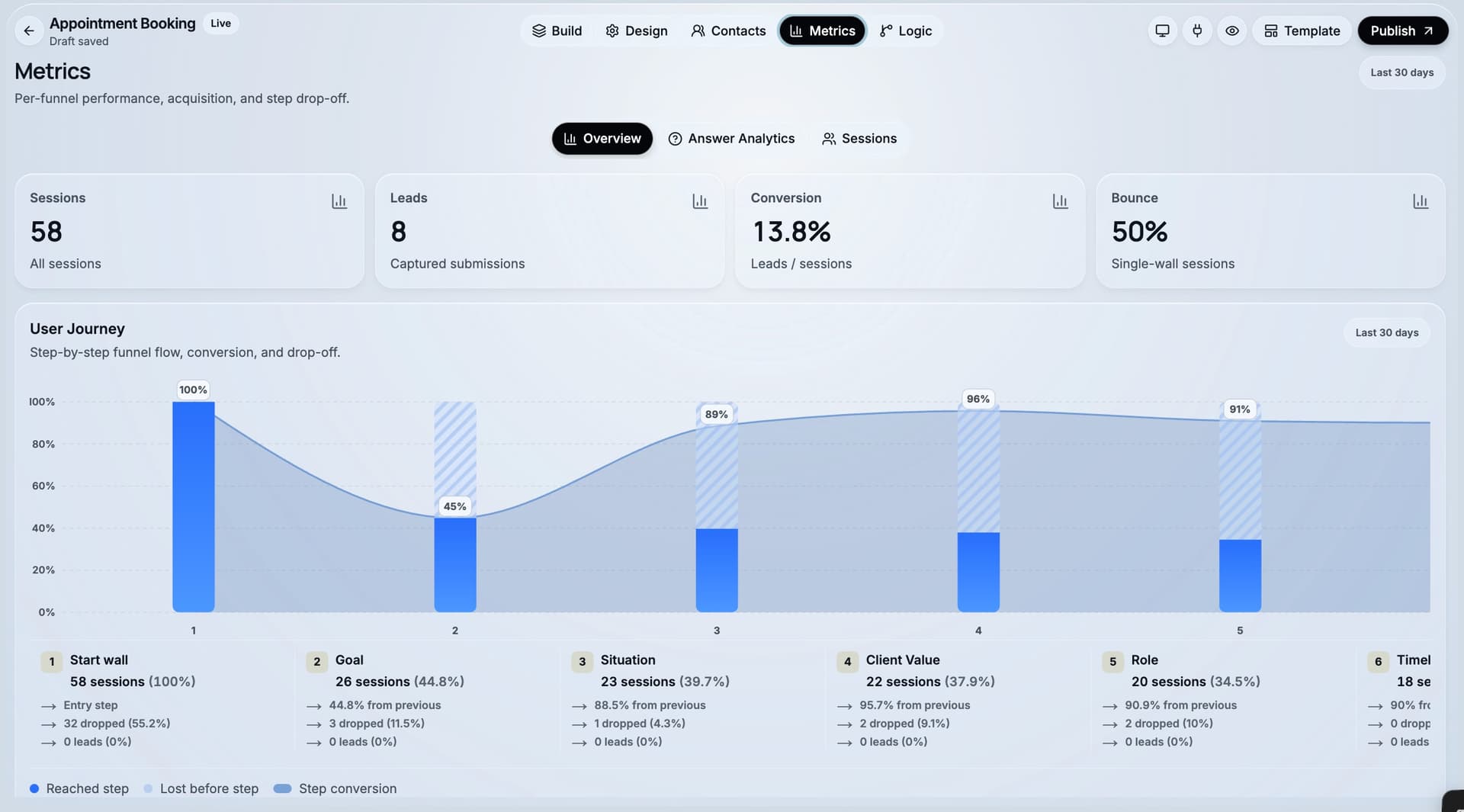
The analytics unit is the step, not the page. In this view the entry wall holds 58 sessions and 55.2% leave before the first question — which is a specific, actionable finding about one screen, not a page-level bounce rate. A landing page can tell you people left. It cannot tell you which question they left on, because there is only one screen to leave.
Speed
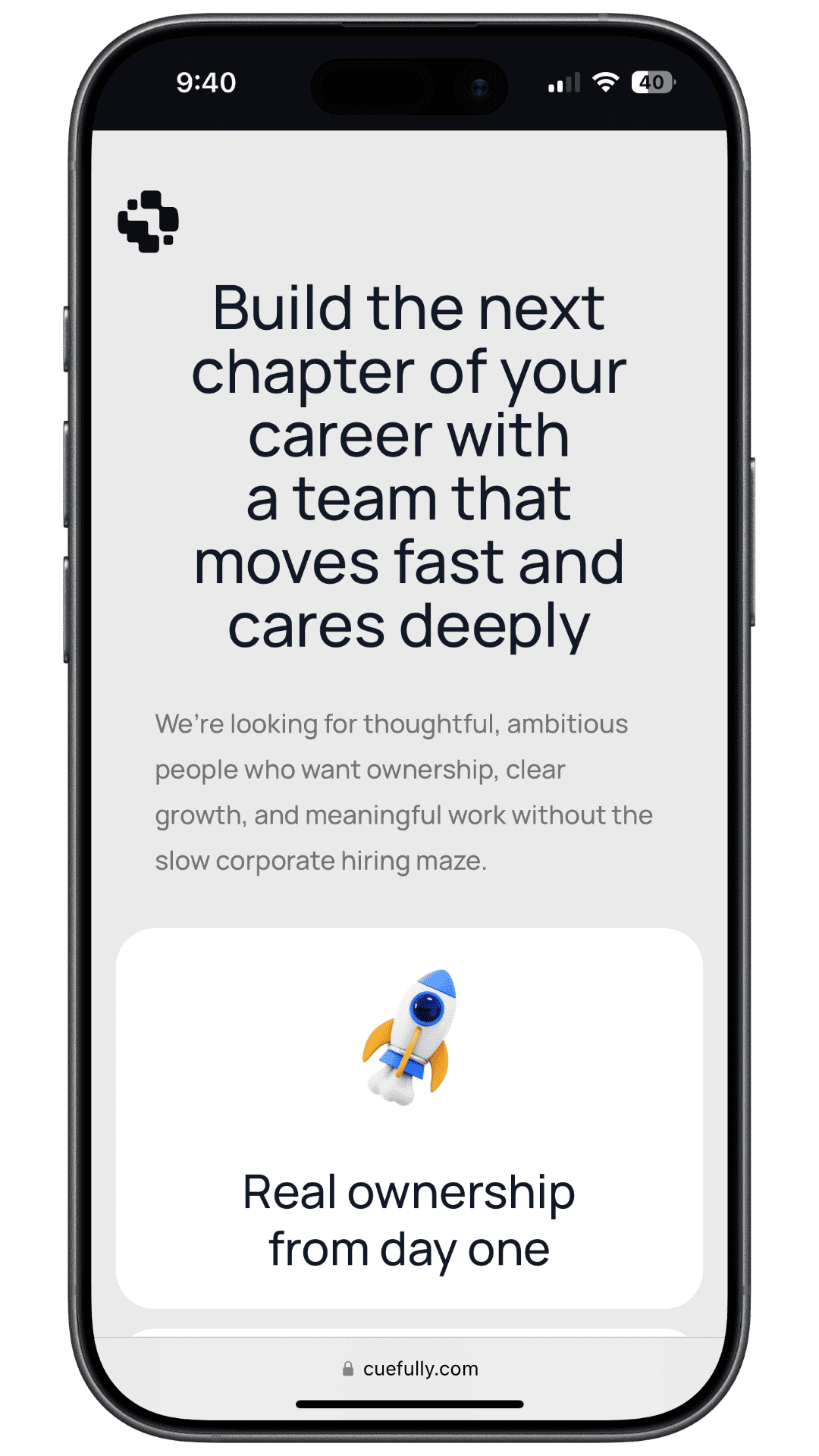
Published funnels are light. The recruitment template ships a 103 KB HTML document and loads in 0.52 seconds (measured 29 August 2026, mobile user agent, document only). The appointment booking template is heavier at 485 KB and 0.81 seconds — worth stating rather than quoting only the better number. On cold paid traffic the load is the first thing the visitor experiences, and the last chance you get.
CueFully vs Instapage, directly
Scope
CueFully has no A/B testing, no server-side split testing, no heatmap recording and no ad-to-page mapping. Page experimentation and behavioural recording are Instapage's domain, and if that is the capability you are hiring for, hire Instapage. CueFully is also not a website builder — it builds funnels, not blogs or multi-page sites.
Pricing (verified 27 August 2026). Base $29/mo · Grow $79/mo · Expand $199/mo · Scale $399/mo. No per-lead fee on any plan.
Pick it if your ads run on paid social and land on a phone, and especially if you run them across a client roster. The template gallery shows the shape better than any description — every template is a working funnel you can open.
2. Heyflow — best if you already want interactive flows
Best for: teams who have reached this article's conclusion independently and want to compare flow-based products properly.
Heyflow builds interactive, step-based lead flows rather than pages, which makes it the closest peer to CueFully in this list. If the argument above lands with you, Heyflow belongs on your shortlist next to us, and saying so is more useful than pretending the category has one occupant.
What it does well. Multi-step interactive flows with conditional logic, a mature builder, and a clear focus on lead generation rather than general page building. It has been in this category longer than we have.
Where the two differ. CueFully configures Meta Pixel and the Conversions API as a single integration; Heyflow treats them as two separate setups. CueFully's organising unit is a client workspace with reusable brand kits, built for agencies running many brands rather than a team running one.
Pricing. Heyflow blocked automated retrieval of its pricing page on 29 August 2026, so we have not quoted figures. Check their site directly, and pay particular attention to how the plan meters responses — in this category that is where commercial models diverge most.
Pick it if you want a second flow-based product to evaluate seriously. Skip it if multi-client workspace isolation is your deciding requirement.
3. Unbounce — best like-for-like swap at a lower entry point
Best for: teams who want Instapage's model with variant testing as the main activity, without Instapage's floor.
Unbounce does substantially the same job as Instapage and enters the range considerably lower. Smart Traffic — routing visitors to the variant most likely to convert them, rather than splitting traffic evenly — is its most distinctive capability and has no direct equivalent in most of this list.
What it does well. A mature page canvas, unlimited A/B testing from the Experiment tier, unlimited conversions on every plan, and AI traffic routing at the top of the range.
Where it falls short. It meters on visitors, and Starter's 500 monthly visitors disappears within days of real campaign spend. The features people buy Unbounce for start at Experiment. And it shares Instapage's underlying assumption — that the page is the thing to optimise — so it is a lateral move if that assumption is what broke. We make that case at length in our comparison of what people actually move to from Unbounce.
Pricing (checked 29 August 2026). Starter $29/mo (500 traffic) · Build $99/mo (20,000) · Experiment $149/mo (30,000, unlimited A/B testing) · Optimize $249/mo (50,000, AI traffic optimization) · Concierge and Agency custom. Annual billing is 25% lower. Unlimited conversions on all plans.
Pick it if you want the same model for less. Skip it if the model is the problem.
4. Leadpages — best for experimentation without enterprise pricing
Best for: teams who want A/B testing, traffic routing and heatmaps without paying enterprise platform prices.
This is the entry most people get wrong, ourselves included until we checked. Leadpages is usually filed as the budget option, but its Optimize plan at $100/month includes A/B testing, Smart Traffic and heatmaps — capabilities that cost $149/month at Unbounce and $199/month at Instapage, with heatmaps at Instapage confined to its custom tier entirely.
What it does well. Unlimited pages from the Grow plan up, no traffic caps and no per-lead fees on any plan — a structurally different model from Unbounce's and Instapage's visitor metering, and materially better if your volume is spiky. Lead enrichment is included, and the cheaper publishing tiers start at $5/month.
Where it falls short. It is built to serve one brand competently rather than a client roster, and workspaces only appear on the $200/month Scale plan. There is no ad-to-page mapping. And it is still a page builder, so everything this article says about the page format applies to it.
Pricing (checked 29 August 2026). Publishing tiers: Starter $5/mo (5 pages) · Pro $15/mo (25 pages) · Business $25/mo (50 pages). Full plans: Grow $50/mo (unlimited pages, 4 sites, manual A/B testing) · Optimize $100/mo (6 sites, A/B testing, Smart Traffic, heatmaps, 3 seats) · Scale $200/mo (10 sites, 10 seats, workspaces). Annual billing saves 20%. No traffic caps or overage fees on any plan.
Pick it if experimentation matters and the budget does not stretch to Instapage. Skip it if you need genuine multi-client separation below $200/month.
5. Landingi — best for agencies producing client pages at volume
Best for: agencies whose actual deliverable is a large number of conventional landing pages across many clients.
Of the page builders here, Landingi takes agency workflow most seriously. White-label output and client management are built into the model rather than retrofitted onto a single-brand product, which is why it survives on agency shortlists that eliminate Leadpages.
What it does well. A large template library, white-label delivery, and client-account structure aimed squarely at agencies producing pages as a service.
Where it falls short. The unit of work is still a page, written before the visitor arrives, unable to learn anything from them. If your clients run Meta and TikTok campaigns you will produce a well-organised library of pages for traffic that would convert better as flows. Ad-to-page mapping at Instapage's depth is not the model here either.
Pricing. Landingi returned HTTP 403 to automated retrieval on 29 August 2026, so we have not quoted figures rather than repeat numbers from a third party. Check landingi.com directly.
Pick it if the deliverable genuinely is pages, at scale, for many clients. Skip it if what your clients need is qualification rather than presentation.
6. Swipe Pages — best for keeping pages and making them fast
Best for: marketers who have diagnosed load time specifically as the problem and want to stay in the page format.
Swipe Pages positions explicitly around speed and mobile-optimised pages, and among conventional page builders it treats load time as a product decision rather than an afterthought. If your pages are genuinely slow, this is the most direct fix on this list.
What it does well. Speed-first page delivery, mobile-oriented templates, and a lighter, simpler product than the enterprise platforms above it.
Where it falls short. Speed and format are independent variables, and this addresses one of them. A fast page that shows a visitor nine fields in a single view is a fast version of the thing that was not converting. It is also a smaller product than Instapage in every other dimension — no ad-to-page mapping, no server-side testing, no heatmaps.
Pricing. swipepages.com refused the connection to automated retrieval on 29 August 2026. We have not quoted figures; check their pricing page directly.
Pick it if you have measured your pages and load time is the finding. Skip it if the diagnosis is the shape of the experience rather than its speed.
7. ClickFunnels — best when the funnel ends in a payment
Best for: businesses selling a product directly, where the sequence ends in a completed transaction rather than a captured lead.
ClickFunnels is a different product category from Instapage rather than a cheaper version of it. It is a sales funnel with commerce attached — checkout, order bumps, upsell and downsell sequences — and for info-product and direct-response businesses it is the correct tool.
What it does well. Unlimited funnels on every plan, a large contact allowance, and the full commerce sequence in one product rather than assembled from three.
Where it falls short as an Instapage replacement. The checkout, order-bump and upsell machinery is the bulk of what you pay for, and a lead-generation campaign uses none of it. It is also the heaviest product here operationally. Our ClickFunnels comparison covers the trade-offs in detail.
Pricing (checked 29 August 2026). Launch $97/mo (10K contacts, 5 domains, 2 team members) · Scale $197/mo (75K contacts, unlimited domains, 5 members) · Optimize $297/mo (150K contacts, 10 members) · Dominate $5,997/year (400K contacts, 20 members). Annual billing is roughly 17% lower. Unlimited funnels on all plans.
Pick it if money changes hands at the end of the sequence. Skip it if the sequence ends at a booked call or a captured lead.
How do you choose the right Instapage alternative?
Work out what you need the software to adapt to, then pick the tool built for that. Four questions settle it.
1. How much does your ad actually tell you about the person? If you run paid search, a great deal — Instapage's model fits that well, and Unbounce or Leadpages give you the same model for less. If you run broad interest or lookalike audiences on Meta and TikTok, very little, and ad-to-page matching is optimising a signal you do not really have.
2. Do you need to learn something the ad cannot tell you? Budget, timeline, role, urgency, headcount, property type. A page cannot ask; it can only display and hope the form gets filled. If qualification decides whether a lead is worth a call, you need something that asks and then acts on the answer. Our guide to multi-step forms covers how to sequence those questions, and the form abandonment statistics we compiled show what asking badly costs.
3. How many pages does your campaign structure imply? Instapage's model multiplies pages by ad groups. Count what you are actually maintaining before switching — if the answer is dozens of near-identical pages, the production cost may be the real problem rather than the software.
4. One brand or many? Client separation and reusable brand kits eliminate most of this category immediately. Landingi and CueFully take multi-client work seriously in different ways — Landingi for pages, CueFully for funnels — and Leadpages only offers workspaces at $200/month.
If your paid-search operation is working and the page count is manageable, stay. Instapage is a strong product for the job it was designed for, and this article is about a different job.
FAQ
What is the best Instapage alternative for Meta and TikTok ad campaigns?
CueFully is the best Instapage alternative for Meta and TikTok campaigns, because it adapts to the visitor's answers rather than to the ad they clicked. On broad interest and lookalike audiences the ad carries little information about the individual, so one tapped question yields more than matching the page to the creative. Heyflow is the other flow-based product worth shortlisting alongside it.
Is there a cheaper alternative to Instapage that still includes A/B testing?
Yes. Leadpages includes A/B testing, Smart Traffic and heatmaps on its Optimize plan at $100/month, against Unbounce's unlimited A/B testing at $149/month and Instapage's server-side A/B testing at $199/month, all checked 29 August 2026. Leadpages also applies no traffic caps or per-lead fees, where Instapage meters unique monthly visitors.
What is ad-to-page personalisation, and does it work on paid social?
Ad-to-page personalisation means serving a landing page whose message matches the specific ad or keyword that brought the visitor. It works well on paid search, where the query itself expresses intent. It works less well on paid social, where interest and lookalike targeting shows one piece of creative to a broad audience, so the ad identifies the campaign rather than the person who tapped it.
Can a landing page builder qualify leads the way a funnel can?
Not in the same way. A landing page is written before the visitor arrives and shows the same content to everyone, so qualification depends entirely on what somebody chooses to type into a form. A funnel asks questions in sequence, branches on the answers and can score them, so qualification happens during the interaction rather than after it.
Why is Instapage more expensive than most landing page builders?
Instapage is priced as an enterprise optimisation platform rather than a page builder. Create is $99/month for 15,000 unique monthly visitors, Optimize is $199/month and adds server-side A/B testing, and Convert is custom-priced with heatmaps and advanced ad-to-page personalisation, all checked 29 August 2026. The pricing assumes enough paid traffic that optimisation pays for itself.
Which Instapage alternative works best for an agency with many clients?
Judge client separation before anything else. CueFully gives each client an isolated workspace with its own funnels, leads and brand kit, switchable in one click, which suits agencies running paid social funnels. Landingi is stronger if your clients genuinely need conventional landing pages produced at volume. Leadpages only introduces workspaces on its $200/month Scale plan, and most other tools treat multi-client work as folders rather than isolated workspaces.
Does CueFully offer heatmaps or server-side A/B testing like Instapage?
No. CueFully has no heatmaps, no A/B testing and no server-side split testing. Its analytics are per funnel step, showing which question caused a drop-off and on what device and traffic source — which answers where people leave a sequence, not which page variant performs better. Teams that need variant testing and behavioural recording should compare Instapage, Unbounce and Leadpages instead.
Should I move off Instapage if most of my traffic is Google Search?
Probably not. Instapage's ad-to-page model is strongest exactly where the keyword carries intent, and its server-side testing and heatmaps have few equivalents at comparable depth. The argument for moving to a mobile funnel applies to cold paid social traffic arriving on a phone. If your traffic is search, changing format solves a problem you do not have.
Why CueFully wins among Instapage alternatives
Because it is the only tool on this list that learns something about the visitor after they arrive.
Every other product here — Instapage included — decides what somebody sees before they show up, using the one signal available at that moment: which ad they clicked. On paid search that signal is rich, and Instapage exploits it better than anyone. On paid social it is thin, and no amount of page optimisation thickens it.
CueFully asks instead. The first tap tells you more about a cold visitor than the creative they came from, and everything after it — the route they take, the score they carry, the copy they read — adapts to that answer. The funnel is built for the phone the ad was served on, loads in about half a second, and separates each client's work into its own workspace with its own brand kit.
That is a different product doing a different job, not a cheaper version of the same one. If your traffic comes from Instagram, TikTok or Meta and lands on a phone, it is the job you actually need done.
See the funnel templates or read how the same argument applies to Unbounce alternatives.
Pricing for Instapage, Unbounce, Leadpages and ClickFunnels was checked on 29 August 2026 from each vendor's own public pricing page. Landingi returned HTTP 403 and Swipe Pages and Heyflow refused automated retrieval on that date, so no figures are quoted for them. CueFully pricing was verified internally on 27 August 2026. CueFully load times were measured on 29 August 2026 with a mobile user agent, document only. Vendors change prices without notice — confirm on the vendor's own site before purchasing.
Build from the guide
Build this funnel in minutes
Start from a proven mobile-first flow, customize it for your client, and publish a funnel that captures qualified leads without adding developer work.